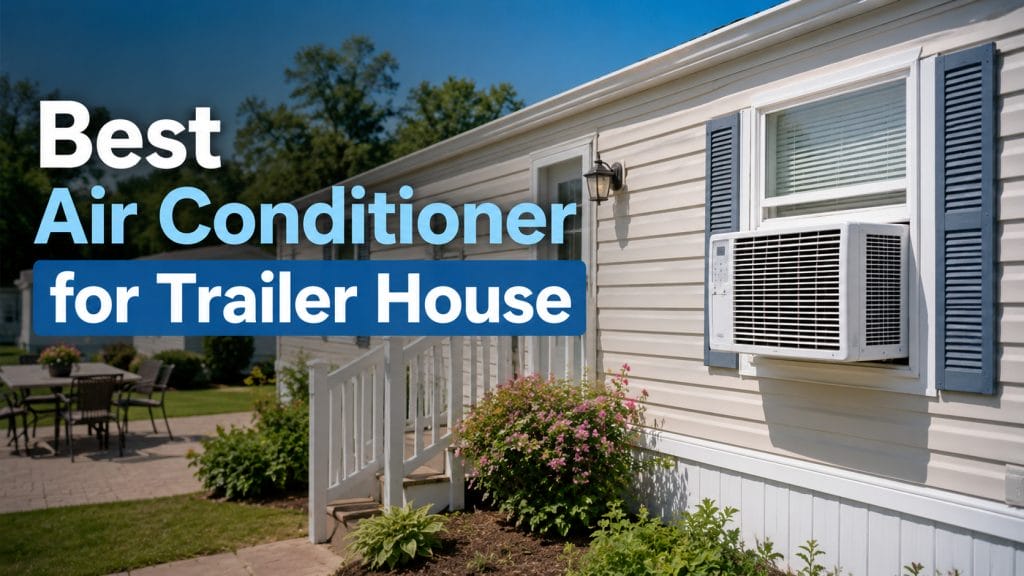
There is a very specific feeling everyone who has lived in a trailer house knows, the moment in early summer when you flip on the AC that came with the place and it just does not keep up anymore. The thin walls and metal roof of a trailer house heat up fast, and by the time the afternoon sun is hitting full force, an underpowered or aging unit is basically just moving warm air around. I went through exactly that in a single wide I manage as a rental, and it sent me down a rabbit hole of testing several different types of units to figure out what genuinely holds up in a trailer house rather than what just looks good on a store shelf.
Over the past year I have installed a small window unit in a spare bedroom, run a portable unit through an entire cooling season in the main living area, and had a ductless mini split professionally installed for whole trailer coverage. Each one has a real place depending on your layout, your budget, and whether you are trying to cool one room or the whole trailer. Here is my current pick for the best air conditioner for a trailer house in 2026.



1. Frigidaire 5,000 BTU Window-Mounted Air Conditioner

For the smallest bedroom in the trailer, this Frigidaire 5,000 BTU unit has been the simplest and most reliable fix I have tried. It covers up to 150 square feet, which was more than enough for the room I put it in, and the quiet 52 dBA operation meant it did not disturb sleep even running through the night. The auto restart feature earned its keep during a storm that knocked out power for a couple of hours, since it came back on with the same settings without any fiddling. Installation was genuinely simple, the extra long power cord reached the outlet without an extension cord, and the adjustable side panels extended out to snugly fit the trailer window frame, which tends to be a slightly different size than a standard house window.
Pros:
- Quiet 52 dBA operation, good for a bedroom
- Auto restart returns to previous settings after a power outage
- Extra long cord reaches outlets without needing an extension cord
- Adjustable side panels fit trailer window frames that run narrower than standard
Cons:
- Only rated for rooms up to 150 square feet
- Mechanical controls only, no remote or digital thermostat
- Two fan speeds is limited compared to higher end units
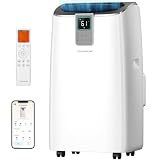
2. BLACK+DECKER Smart Portable Air Conditioner, 14,000 BTU

The living room and kitchen area in most trailer houses share one open space, and this BLACK+DECKER portable unit was the one that actually kept up with that combined square footage. Rated for up to 700 square feet, it cooled the open living area without needing any permanent installation, which mattered since I did not want to cut into the trailer’s exterior wall. The wifi app let me start cooling before getting home, and the Follow Me remote reading the temperature from across the room made a noticeable difference compared to a unit that only reads its own internal sensor. The included window kit worked fine on the trailer’s sliding window once I adjusted the panel width.
Pros:
- Covers up to 700 square feet, enough for an open concept living and kitchen area
- No permanent installation or wall modification required
- Wifi app plus Alexa and Google Assistant compatibility
- Follow Me remote improves temperature accuracy across a larger room
Cons:
- Heavy at over 68 pounds, not easy to relocate often
- Window kit installation takes a bit more setup than a fixed window unit
- Higher price point than a basic window unit
3. Albott 12,000 BTU Mini Split Air Conditioner and Heater

When the window and portable units were not quite enough for whole trailer comfort, I had this Albott mini split professionally installed as a more permanent solution, and it has been the single biggest upgrade for the property. Rated for spaces up to 750 square feet, which covers most single wide trailers, the ductless design meant there was no need to retrofit ductwork that trailer houses often were not built with in the first place. The SEER2 18 rating and inverter heat pump technology brought the electric bill down noticeably compared to running the old window units around the clock, and since it also heats down to 5°F outside temperature, it doubled as a heating source once the weather turned. At under 29dB it is close to silent, which is a big change from the constant hum of a window unit.
Pros:
- Ductless design avoids the need to retrofit trailer ductwork
- Covers up to 750 square feet, enough for most single wide trailers
- SEER2 18 rating delivers real energy savings over standard window units
- Also functions as a heater down to 5°F, useful for colder months
Cons:
- Requires professional installation, not a DIY weekend project
- Higher upfront cost than window or portable options
- At 151 pounds, the indoor and outdoor components need proper mounting
4. Midea 6,000 BTU Window Air Conditioner

For a mid sized bedroom or a home office space, this Midea EasyCool unit ended up being the right middle ground between the smaller Frigidaire and a full sized portable unit. Covering up to 250 square feet, it handled a converted bedroom in the trailer that the small 5,000 BTU unit would have struggled with. The dehumidifier mode has been genuinely useful during humid stretches, cutting down on the sticky feeling trailer houses can get since they tend to have less overall airflow than a stick built home. The remote and LED display made day to day adjustments easy, and installation into the existing window frame took under half an hour with a basic screwdriver.
Pros:
- Covers up to 250 square feet, a solid middle ground for a bedroom or office
- Dehumidifier mode helps with humidity that builds up in trailer houses
- Remote control and LED display for easy adjustments
- Straightforward installation into an existing window frame
Cons:
- Screwdriver required for installation, not entirely tool free
- No wifi or smart home connectivity
- 38 pounds makes it a two handed lift during install
5. Hisense 8,000 BTU Portable Air Conditioner with Dual Hose and Inverter

The last unit I tested was this Hisense portable AC, and the dual hose design turned out to make a real difference in a trailer house specifically. Single hose portable units can pull in outside air to replace what they exhaust, which is more noticeable in a trailer’s thinner, less sealed construction, and the dual hose setup on this Hisense unit reduced that effect noticeably. The inverter technology claims up to 40 percent better efficiency than a standard compressor, and after a full month of use my electric bill backed that up compared to an older single hose unit I had used previously. At 42 dB it runs quieter than most portable units, and the ConnectLife app gave me wifi control along with Alexa and Google compatibility.
Pros:
- Dual hose design reduces the negative pressure effect common in trailer houses
- Inverter technology delivers real energy efficiency gains
- Quiet operation at 42 dB
- Wifi app control with Alexa and Google Assistant support
Cons:
- Covers up to 350 square feet, not enough for a whole open concept trailer
- Heavier than single hose portable units at 65 pounds
- Shorter 90 day warranty on this listing compared to some competitors
Final Thoughts
The right air conditioner for a trailer house really depends on whether you are cooling one room or trying to cover the whole place. For a single small bedroom, the Frigidaire 5,000 BTU window unit is hard to beat on price and simplicity. For an open concept living area, the BLACK+DECKER portable unit or the dual hose Hisense both handle larger spaces without needing permanent changes to the trailer. And if you are ready to invest in a long term fix, the Albott mini split has genuinely changed how comfortable the whole trailer feels while also cutting the electric bill. Whatever you choose, pay attention to the actual square footage rating rather than just the BTU number, since trailer houses with their thinner insulation often need a bit more cooling capacity than a stick built home of the same size.