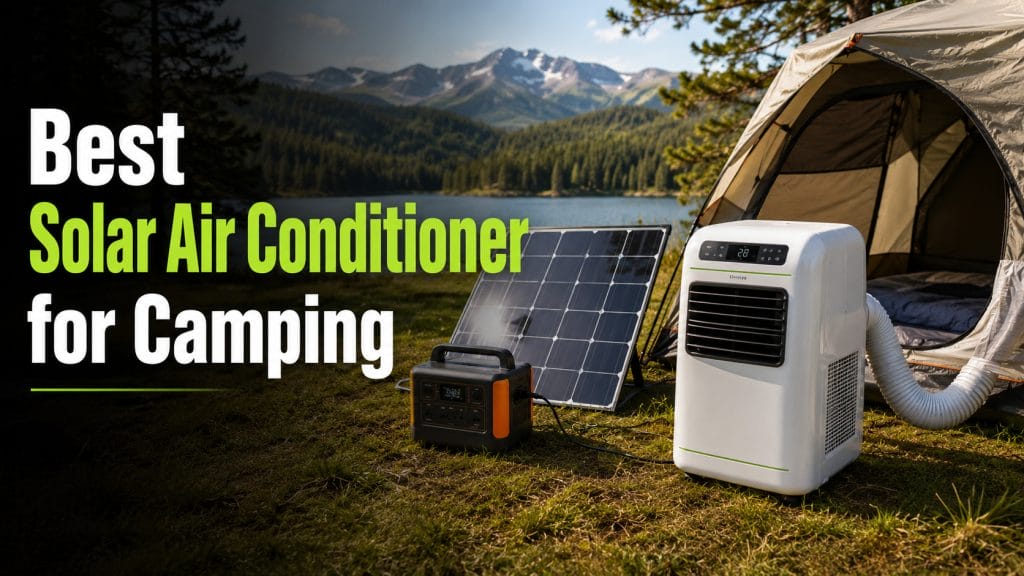
After digging through this category for actual camping trips off the grid, I found something worth being upfront about, true solar air conditioners with a built-in panel input barely exist. What you actually find, and what I have tested myself, are low draw compressor units built to run cleanly off a solar charged power station. Below is my honest pick of the best solar air conditioner for camping in 2026, limited to the units that genuinely pair with off-grid solar power rather than every camping AC that happened to show up in a search.


Buying Guide: What Solar Compatible Actually Means for a Camping Air Conditioner
Before buying anything labeled solar for camping, it helps to understand what that claim usually covers.
Direct solar input versus power station compatibility. A small number of units, like the EcoFlow WAVE 3, accept solar charging directly into their own battery. Most other camping air conditioners run on standard AC power and rely on a separate portable power station, such as a Jackery or EcoFlow unit, which is then charged by solar panels. Both approaches work off-grid, but only the first is truly solar-ready on its own.
Wattage draw matters more than BTU rating. A unit rated at 400W or less is far easier to sustain on a modest solar setup than a full size compressor AC pulling 1000W or more. Check the rated power consumption, not just the cooling capacity, before assuming your panels and battery can keep up.
Battery capacity determines actual runtime. If you are pairing a unit with a power station, do the math on your battery’s watt-hour rating divided by the AC’s wattage draw to estimate real runtime between charges, then compare that against how many sun hours you can realistically expect to recharge during the day.
Compressor units outperform evaporative coolers in humid climates. Small personal evaporative coolers use very little power, but they only work well in dry conditions and cool a person rather than a tent. For genuine tent or enclosure cooling, a real compressor based unit is worth the extra power draw.
Confirm the enclosure size the unit is rated for. Camping air conditioners in this category are usually built for small, sealed spaces under 150 square feet, not full rooms, so match the unit to your tent or enclosure size rather than assuming more BTUs always means better performance.
1. EF ECOFLOW WAVE 3 Portable Air Conditioner

This is the closest thing to a genuinely solar-ready camping air conditioner in this list. The WAVE 3 uses a 1024Wh LFP battery for up to 8 hours of cordless operation, and it charges through AC power, an EcoFlow Alternator Charger, a car outlet, or solar panels directly, with 1000W ultra-fast charging that can reach a full charge in about 75 minutes. It maintains comfortable temperatures in 120 to 180 square foot spaces and includes app control for temperature, mode, and timer along with a 44dB sleep mode.
Pros:
- Genuine solar charging input built into the unit itself
- Cordless operation for up to 8 hours on a full charge
- App control with real-time power monitoring and water and power alerts
Cons:
- Significantly higher price than standard plug-in camping units
- Best suited to smaller enclosures at 120 to 180 square feet
2. Movejoy 3000 BTU Portable Air Conditioner

Movejoy takes a different approach, using a genuine rotary compressor rather than a peltier based ice fan, and it is specifically built to run on portable power stations like Jackery and EcoFlow, which is where the solar connection comes in for most campers. Rated at just 400W, it drops temperatures by 15°F in 30 minutes and is intentionally limited to enclosures under 80 square feet, which the brand states keeps efficiency and lifespan high.
Pros:
- Real compressor cooling rather than a peltier ice fan
- Low 400W draw designed to run well on solar charged power stations
- 40dB whisper-quiet sleep mode for undisturbed rest
Cons:
- Strictly limited to enclosures under 80 square feet by design
- Not powerful enough for vehicle cabins or larger rooms
3. FO-KOKO 5200 BTU Portable Camping Air Conditioner

FO-KOKO uses dual-loop water cooling to generate colder airflow than a standard compressor design, all while running on just 400W. It is explicitly compatible with 110V AC, 1500W and larger power stations, and EV V2L output, covering 130 square feet and dropping temperature by 18°F within 5 minutes. Four modes including cooling, dry, sleep, and fan are paired with a 24 hour timer and drain-free operation under 70 percent humidity.
Pros:
- Explicitly rated to run on 1500W and larger power stations
- Dual-loop water cooling adds extra cooling performance at low power draw
- Drain-free operation under normal humidity conditions
Cons:
- No direct solar panel input, still requires a power station in between
- Compatible power station adapters are sold separately
Final Thoughts
If a direct solar connection matters most to you, the EcoFlow WAVE 3 is the only unit here that genuinely takes a solar panel input on its own, though it comes at a real price premium. For campers who already run or plan to run a solar charged power station, the Movejoy and FO-KOKO units are both built around low enough wattage draw to make that pairing practical, without the higher cost of an all-in-one solar system. Whichever route you take, check the actual wattage draw against your solar and battery setup before buying, since that number matters far more than the BTU rating printed on the box.