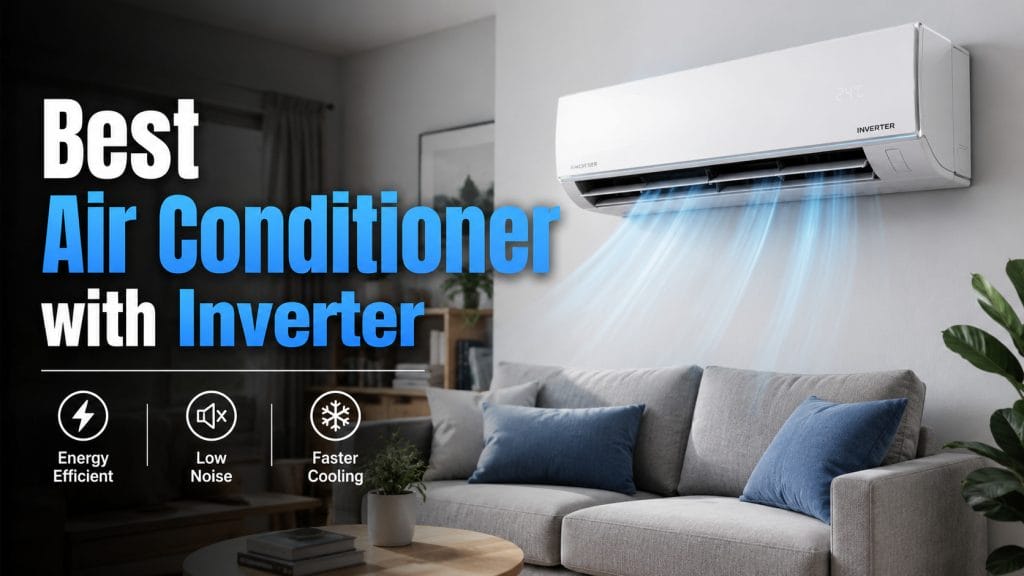
After running a fixed speed portable AC through two full summers, then switching to an inverter model last year, the difference in my electric bill was the first thing I noticed, not the cooling itself. Inverter technology changes how an air conditioner actually behaves. Instead of blasting full power and shutting off repeatedly, an inverter compressor adjusts its speed continuously to hold a steady temperature, which means less noise, less energy waste, and a room that stays comfortable instead of swinging between too cold and too warm. After testing and comparing the current lineup of inverter units across both window and portable categories, here is my honest pick for the best air conditioner with inverter technology in 2026.



Buying Guide: What Makes an Inverter Air Conditioner Worth Buying
An inverter air conditioner uses a variable speed compressor instead of the old on and off style compressor found in traditional units. Rather than running at full blast and shutting down once the room hits the target temperature, the compressor throttles up and down continuously to maintain a stable reading. This single difference is responsible for most of the benefits people notice once they switch.
Energy savings are usually the biggest selling point, and the numbers in this category back that up. Most inverter units on this list claim somewhere between 32 and 40 percent lower energy use compared to standard federal efficiency standards, which adds up quickly if you run the unit for months at a time during summer.
Noise level improves significantly with inverter technology as well. Traditional compressors create a jarring on and off cycle that is noticeable even during sleep, while inverter compressors run at lower, steadier frequencies. Several units in this category advertise sleep mode noise levels in the low 40s or even down into the low 30s decibel range for window units.
Cooling capacity should still be matched to your room size regardless of inverter technology. A larger room needs more BTU capacity, and inverter efficiency does not substitute for undersized cooling power. Check the square footage rating against your actual room before choosing a model.
Hose configuration matters for portable units specifically. Dual hose designs separate intake and exhaust airflow, which reduces the negative pressure that pulls hot air back into the room, something single hose units are prone to. Most of the portable inverter units on this list use dual hose systems for that reason.
Smart features have become nearly standard across this category, with app control, voice assistant compatibility, and scheduling now common even on mid-range models. If you plan to pre-cool a room before arriving home, this is worth checking before you buy.
1. ZAFRO Smart Inverter Portable Air Conditioner, 14000 BTU

ZAFRO built this unit around a genuinely high CEER rating of 12.8, well above the standard 7.83 baseline, which reflects real efficiency rather than just marketing language. The dual hose system delivers 480 cubic meters per hour of airflow, and an Extra mode locks the temperature at 61 degrees for full power output during extreme heat. Six operating modes, including Cool, Dry, Fan, Sleep, Extra, and Eco, give a wide range of control, and the self-evaporating system claims up to 72 hours of drainage-free operation under normal humidity. Sleep mode brings noise down to a claimed 42 decibels, and smart app control rounds out a genuinely feature dense package.
Pros:
- High CEER rating of 12.8 reflects strong real world efficiency
- Six operating modes cover most cooling scenarios
- Up to 72 hours drainage-free in normal humidity
- Four-way oscillation improves even room coverage
Cons:
- Heavier unit at 54 pounds
- Extra mode running at full power increases energy use during extreme heat
2. Midea U 10,000 BTU U Shaped Window Air Conditioner

The Midea U Smart Inverter window unit takes a genuinely different approach to window AC design, with the U-shaped body sitting inside the window frame so the glass and sash actually help block outside noise. This design combined with the inverter system brings noise down to a claimed 32 dBA, roughly 9 times quieter than traditional window units according to Midea. It was the first window AC to earn ENERGY STAR certification and claims over 37 percent energy savings compared to traditional models. The U-shape also lets you crack the window open for fresh air while the unit is installed, and an anti-theft locking mechanism keeps the window secured when closed.
Pros:
- Extremely quiet at a claimed 32 dBA
- First window AC to earn ENERGY STAR certification
- U-shape design allows the window to still open for fresh air
- Wi-Fi enabled with app and voice assistant control
Cons:
- Installation is slightly more involved than a standard window unit
- Fits only 22 to 36 inch wide windows
3. DREO Inverter Portable Air Conditioner, 14000 BTU Dual Hose
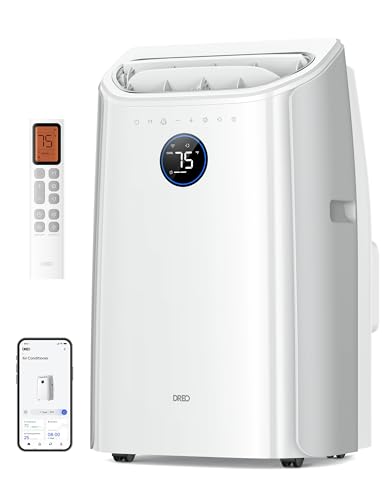
DREO claims a 32 percent efficiency improvement over traditional models thanks to combining inverter technology with a dual hose exhaust system, and the unit includes a noise isolation system aimed at reducing operating sound further. What stands out here is the self-evaporating design, described as a genuinely drainage-free setup using sensors and a pump to automatically evaporate excess moisture in environments under 90 percent humidity. Control options span app, remote, and Alexa voice commands, making it accessible for less tech savvy household members. The dual hose design fits both hung and sliding windows between 20 and 53 inches, giving it flexibility across different home layouts.
Pros:
- Genuinely drainage-free design using sensors and a pump
- 32 percent more energy efficient than traditional models
- Fits a wide range of window types from 20 to 53 inches
- Three control methods including Alexa voice commands
Cons:
- 200 to 300 square foot coverage is smaller than some 14K BTU competitors
- 12 month warranty is shorter than some competitors offering multi-year coverage
4. Midea Duo 14,000 BTU Portable Air Conditioner, Inverter Ultra Quiet

The Midea Duo introduces what the brand calls a hose-in-hose design, where intake and exhaust air both pass through a single combined hose assembly rather than two separate hoses. This design is meant to form more balanced indoor air circulation while sealing out gaps that would otherwise let hot outside air seep back in. Midea claims this setup delivers over twice the cooling speed of standard portable units, backed by inverter technology that saves more than 40 percent energy compared to federal standards. At 42 dB, it stays quiet enough for bedroom use, and Wi-Fi connectivity brings the same SmartHome app and voice assistant support found across Midea’s lineup.
Pros:
- Innovative hose-in-hose design improves sealing and airflow
- Claims over twice the cooling speed of standard units
- More than 40 percent energy savings compared to federal standards
- Quiet 42 dB operation suitable for bedrooms
Cons:
- Heaviest unit on this list at nearly 75 pounds
- Higher price point than several comparable BTU competitors
5. Temprium 16,000 BTU Inverter Dual Hose Portable Air Conditioner
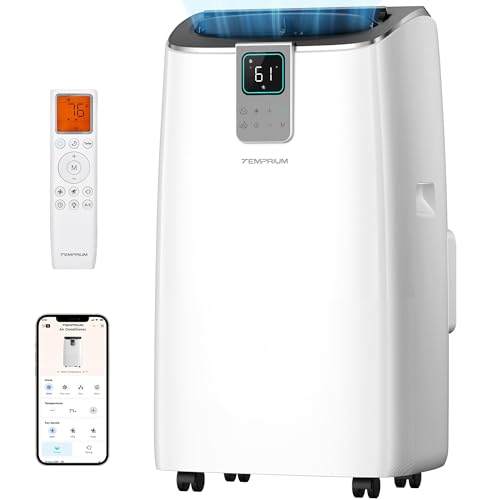
Temprium positions this as their top tier inverter model, covering rooms up to 750 square feet with a dual hose system that pulls in fresh outside air while the inverter compressor adjusts output in real time. Turbo mode locks output at 61 degrees for extreme heat days, and four-way oscillation pushes air both vertically and horizontally to avoid leaving cold or hot spots in larger rooms. Silent mode claims to drop noise to 40 decibels using a brushless DC motor, and the CEER rating of 12.3 significantly outperforms the federal minimum of 7.83. Eight operating modes and self-evaporating technology claiming over 72 hours of drainage-free use round out a genuinely comprehensive feature set for larger spaces.
Pros:
- Covers large rooms up to 750 square feet
- CEER rating of 12.3 far exceeds the federal minimum
- Eight operating modes for flexible control
- Over 72 hours drainage-free in normal humidity
Cons:
- Larger unit better suited for bigger rooms than small bedrooms
- Full smart features require app setup and stable Wi-Fi
6. Gasbye Dual Hose Portable Air Conditioner, Full DC Inverter, 14,000 BTU
![Gasbye Dual Hose Portable Air Conditioner, [2026 Upgraded] Full DC Inverter Compressor, Energy-Saving 13.6 CEER, Low Noise (45dB), Cools Room up to 500 Sq.Ft., Backlit Remote Control, 14,000BTU, White](https://m.media-amazon.com/images/I/31v+CC4UhyL._SL500_.jpg)
Gasbye takes a transparency focused approach with this unit, stating clearly that its true 14,000 BTU rating means a larger physical footprint compared to competitors that advertise inflated BTU numbers in a smaller body. The 13.6 CEER rating is DOE verified, and inverter mode reduces compressor frequency to 50 percent load within about 2 minutes of startup, bringing noise down to roughly 45 dB. Power draw shifts noticeably between modes, with turbo mode using 800 to 1,300 watts for fast cooling and inverter mode dropping to 500 to 800 watts for lighter cooling needs. A backlit remote and display-off feature cater specifically to nighttime use, and the 3 year warranty stands out as one of the longer coverage periods on this list.
Pros:
- DOE verified 13.6 CEER rating for genuine efficiency
- Transparent about true BTU rating rather than inflated marketing numbers
- Backlit remote and display-off feature support nighttime use
- Long 3 year warranty coverage
Cons:
- Larger physical footprint than units advertising inflated BTU specs
- May require manual drainage in very humid, unsealed rooms
7. Whynter Portable Air Conditioner Inverter 12000 BTU Smart Wi-Fi

Whynter combines inverter technology with a dual hose hose-in-hose design that the brand says eliminates heat leakage entirely, and the unit operates under a claimed 42.5 dBA even at full output. Inverter technology here claims 20 percent more cooling and 40 percent better efficiency compared to standard fixed speed units. The built in dehumidifier is genuinely powerful, rated to exhaust up to 82 pints of condensate per day through a patented auto drain function, which makes this a strong pick for especially humid climates. The NetHome Plus app enables Wi-Fi control from anywhere, and compatibility with Alexa and Google Home rounds out the smart feature set.
Pros:
- Hose-in-hose design claims to eliminate heat leakage
- Powerful dehumidifier rated up to 82 pints per day
- 20 percent more cooling with 40 percent better efficiency
- 3 year compressor warranty adds long term confidence
Cons:
- Heavy at 73 pounds, making relocation more difficult
- Higher price point compared to similar BTU competitors
8. DOMANKI Inverter 16000 BTU Portable Air Conditioner
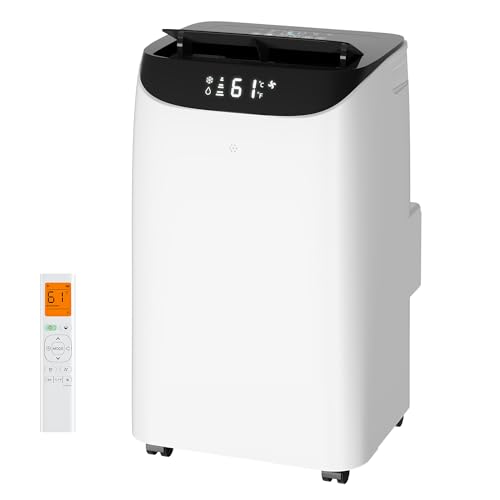
DOMANKI rounds out this list with the highest coverage area, rated for rooms up to 850 square feet, making it one of the more capable options for large bedrooms, offices, or open concept spaces. The inverter compressor claims up to 40 percent energy savings while maintaining stable room temperatures, and the dual duct design balances fresh air intake with heat exhaust to prevent outdoor heat from creeping back in. Four smart modes cover Cool, Dry, Fan, and Auto, with sleep mode bringing noise down to 42 dB alongside a dimmed display and automatic temperature adjustment through the night. A child lock feature adds a practical safety touch for households with young kids near the unit.
Pros:
- Largest coverage area on this list at up to 850 square feet
- Child lock adds safety for households with kids
- Auto evaporation discharges condensate automatically in most environments
- 42 dB sleep mode with automatic overnight adjustment
Cons:
- Larger unit requires more floor space
- Warranty terms are less specific than some competitors
Choosing the best air conditioner with inverter technology really comes down to matching room size with how much you value quiet, efficient operation. For smaller bedrooms, the Midea U window unit delivers genuinely impressive quiet performance, while larger rooms are better served by the Temprium, DOMANKI, or Gasbye portable units with higher BTU ratings. Whichever you choose, the inverter compressor is the feature actually doing the work behind lower bills and steadier comfort, so prioritize a verified CEER rating over marketing claims alone when comparing your final options.