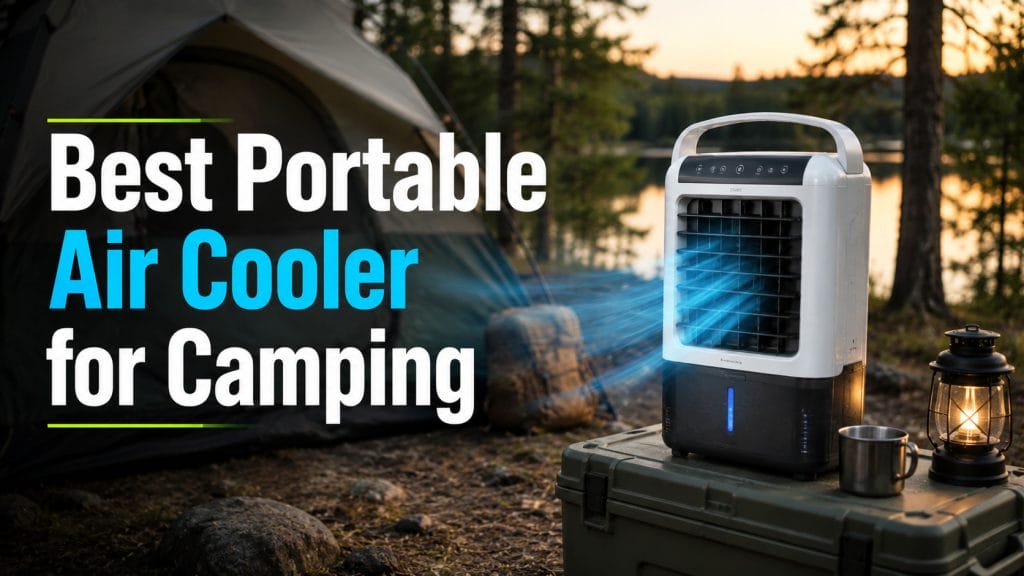
Do you go with a small battery powered personal cooler that fits in your backpack, or a full tent air conditioner that actually drops the temperature inside your setup? That was the exact question I wrestled with before a week long camping trip last summer, and after testing both ends of the spectrum I learned that the right answer depends entirely on whether you are cooling yourself at a campsite table or trying to sleep comfortably inside a hot tent overnight. This guide covers the best portable air cooler for camping in 2026, based on real cooling power, battery or power source flexibility, noise level, and how each one actually performed outdoors.


Buying Guide: What to Look for in a Portable Air Cooler for Camping
Choosing the right cooler for camping depends heavily on how you camp and what kind of cooling you actually need.
Cooling type matters most. Compressor based tent air conditioners with a real BTU rating drop the actual temperature inside an enclosed space, while evaporative personal coolers only cool the air immediately around you and work best in dry climates.
Power source flexibility is critical outdoors. Compressor units typically need a wall outlet or a generator, while personal evaporative coolers often run on USB power banks, car chargers, or built-in rechargeable batteries, making them far more flexible for tent camping without hookups.
Battery life determines how long cordless cooling lasts through the night. Look for a rated runtime of at least 4 to 8 hours if you plan to run a personal cooler without access to power overnight.
Noise level affects sleep quality in a quiet campsite. Personal evaporative coolers tend to run under 40 decibels, while compressor based tent units run closer to 50 to 58 decibels in sleep mode, which is still much quieter than most portable generators.
Weight and size matter more for camping than home use. A unit under 3 pounds fits easily in a backpack or car trunk, while larger tent AC units around 30 pounds are better suited to car camping or RV setups rather than backpacking trips.
Water tank capacity affects how often you need to refill during a trip. Larger tanks around 40oz or more reduce the need for frequent water runs, which matters more at a remote campsite than at home.
1. outohome Portable Camping Air Conditioner 5200 BTU

This was the unit that actually made a difference inside my tent rather than just around my immediate seating area. The GMCC compressor delivered a real 18 degree Fahrenheit temperature drop within about five minutes, which evaporative coolers simply cannot match. At just under 32 pounds with a handy grip, it was manageable for car camping even though it is not something you would carry on a backpacking trip. Running in sleep mode, the compressor noise stayed low enough that it did not disrupt my rest, with only a gentle fan sound audible.
Pros:
- Real compressor cooling drops temperature by up to 18 degrees Fahrenheit
- Compact and lightweight at just under 32 pounds for its cooling power
- Drainage-free operation below 70 percent humidity
Cons:
- Requires a standard power outlet or generator, not battery powered
- Too bulky for backpacking, better suited to car camping or RV use
2. Wszrfozn 7000 BTU Portable Camping Air Conditioner

For a larger tent or a group campsite, this unit’s higher BTU rating provided noticeably stronger cooling than the smaller 5200 BTU options I tested alongside it. The 4-in-1 mode selection covered everything from a quick cooldown to overnight sleep mode, and the remote control meant I did not have to get up and fumble with buttons in the dark. At 58 decibels in sleep mode it was audibly louder than the smaller compressor unit, but still far quieter than running a portable generator nearby.
Pros:
- Stronger 7000 BTU cooling suited to larger tents or RVs
- Full remote control access to all four modes
- Rapid cooldown within about 5 minutes of startup
Cons:
- Heavier at 36 pounds compared to the 5200 BTU alternative
- Higher power draw at up to 550 watts
3. Evapolar evaCHILL Portable Air Conditioner

This was my go-to for personal cooling at the campsite table rather than inside the tent itself, and its USB power compatibility meant I could run it straight off a power bank without needing an outlet anywhere nearby. At just 10 watts of power consumption, it barely made a dent in my portable battery’s charge over a full afternoon of use. The basalt fiber cooling cartridge felt like a more premium build than the plastic evaporative units I compared it against, and the compact 6.5 inch cube shape fit easily into a side pocket of my camping bag.
Pros:
- USB powered, compatible with power banks and car outlets
- Extremely low 10 watt power consumption
- Compact cube design fits easily into camping gear
Cons:
- Only cools the immediate 3 to 5 foot area around the unit
- Less effective in humid climates above 70 percent relative humidity
4. Tiptop Home 5-in-1 Mini AC Fan with App Control

The built-in 2000mAh rechargeable battery on this unit made it the most genuinely cordless option I tested, delivering up to 12 hours of use without needing to be plugged in at all. The included ice crystal boxes noticeably improved the cooling effect compared to using tap water alone, and having smartphone app control meant I could adjust fan speed and mist settings without reaching over from my sleeping bag. At just 1.3 pounds it was also the lightest option I packed for the trip.
Pros:
- Built-in rechargeable battery delivers up to 12 hours of cordless use
- Smartphone app control for fan speed, mist, and lighting
- Lightest option tested at just 1.3 pounds
Cons:
- Smaller 800ml water tank requires more frequent refills
- Personal cooling range only, not suited to cooling a full tent
5. Arctic Air Pure Chill 2.0 Evaporative Air Cooler

This was the most budget friendly option in my lineup, and it still delivered a noticeable cooling effect at the picnic table during a hot afternoon. Running for up to 10 hours per fill depending on the speed setting, it required less attention than some of the smaller tank units I tested. The multi-directional air vents let me point the airflow exactly where I wanted, and the 7 color LED night light doubled as a subtle camp light after dark.
Pros:
- Affordable price point compared to compressor based units
- Runs up to 10 hours on a single water fill
- Multi-directional vents let you aim airflow precisely
Cons:
- Requires a standard power outlet rather than battery operation
- Personal cooling only, not effective for a full tent
Choosing the right portable air cooler for camping comes down to whether you need to cool an enclosed tent or just yourself at the campsite. For a real temperature drop inside your tent, the outohome and Wszrfozn compressor units deliver genuine compressor based cooling. For lightweight, battery friendly personal cooling that fits in a backpack, the Evapolar evaCHILL and Tiptop Home options are hard to beat, while the Arctic Air Pure Chill offers a solid budget pick for car camping with outlet access.