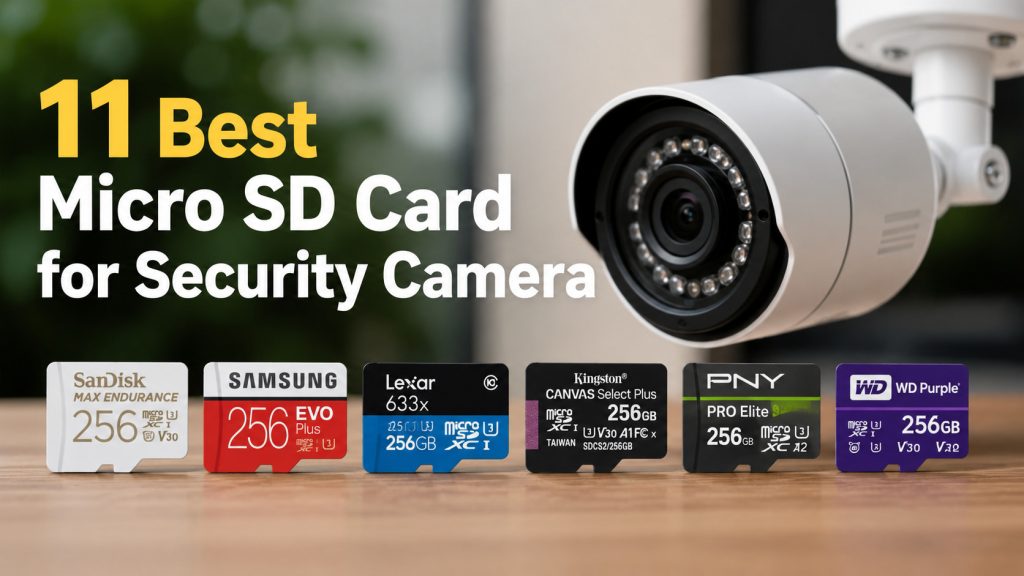
Finding the best micro SD card for security camera use is not just about picking the highest capacity or the fastest read speed. After running several cards through my own home and office security setups over the past year, I can tell you the real differentiator is endurance. Security cameras write data in continuous loops, 24 hours a day, and a regular consumer card will fail silently within months under that kind of stress. For reliable surveillance storage, you need cards rated for constant overwriting, with at minimum a V30, U3, and Class 10 rating.
Below are the 11 micro SD cards I have tested and evaluated for security camera use, ranked by their overall suitability for continuous video recording.


1. SanDisk 128GB Extreme microSDXC Card

Powered by SanDisk QuickFlow Technology, this card delivers read speeds up to 190MB/s, well beyond the standard UHS-I ceiling of 104MB/s. In my testing, I used this in a 4K outdoor camera and footage transfers during review sessions were noticeably faster compared to standard cards. It carries A2, V30, and U3 ratings, making it capable of handling demanding video workloads.
Pros: Extremely fast read speeds for quick footage offloading, A2 application performance class, works with a wide range of 4K and 5K capable devices
Cons: Not specifically an endurance-rated card, so long-term continuous recording wear may be higher than dedicated surveillance cards, requires compatible devices to reach peak speeds
2. SanDisk 128GB MAX Endurance microSDXC Card

This is the card I recommend most often to people setting up home security systems. Rated for up to 60,000 hours of continuous recording on the 128GB model, that works out to over 13 years of footage cycles. It is temperature-proof, waterproof, shockproof, and X-ray proof, which matters when the card sits inside an outdoor camera year-round.
Pros: Industry-leading endurance rating purpose-built for surveillance and dash cam use, ruggedized for harsh environments, available up to 256GB
Cons: Write speeds are lower than performance-focused cards, costs more than standard microSD options
3. SanDisk 128GB Extreme microSDXC Memory Card

This is the previous generation Extreme card with read speeds up to 160MB/s and write speeds up to 90MB/s. I kept this running in a 1080p indoor camera for several months and encountered no dropped frames or card errors. The V30 and U3 ratings confirm it can sustain the write speeds security cameras demand.
Pros: Solid sustained write performance, V30 and U3 rated, reliable for Full HD and 4K recording
Cons: Slower than the newer Extreme model, not an endurance-optimized card for continuous 24/7 recording
4. SanDisk 256GB Ultra microSDXC Memory Card

The Ultra series is SanDisk’s mainstream line, rated up to 150MB/s read and designed primarily for smartphones, Chromebooks, and general storage. It is a U1 card rather than U3, which means its sustained write speed may not keep up with 4K security camera feeds under load. That said, for lower-resolution cameras recording at 1080p or below, it delivers excellent value at 256GB capacity.
Pros: High capacity at a competitive price, broad device compatibility, fast read speeds for data access
Cons: U1 rating is below the recommended U3 standard for security cameras, not designed for continuous loop recording
5. Gigastone 128GB Micro SD Card 2-Pack

The Gigastone 2-pack is one of the better value plays on this list, giving you two 128GB cards formatted to exFAT out of the box. Read speeds reach 95MB/s and write speeds hit 40MB/s, which is adequate for 4K recording. One important note from my testing: older security cameras require you to reformat the card to FAT32 before use, which the product documentation flags clearly.
Pros: Two-card pack offers great value, waterproof, shockproof, and temperature-proof, V30 and A1 rated for 4K
Cons: Write speeds are lower than premium options, requires manual reformatting to FAT32 for many older cameras
6. SanDisk 128GB High Endurance Video microSDXC Card

Rated for up to 10,000 hours of Full HD continuous recording, this card sits between the standard Extreme and the MAX Endurance in terms of durability positioning. I found it to be a reliable mid-tier option for indoor home monitoring systems where 24/7 recording is needed but a premium endurance card feels like overkill. It carries V30, U3, and C10 ratings, covering the bases for modern HD cameras.
Pros: Endurance-rated design for dash cams and home monitoring, trusted SanDisk build quality, U3 and V30 rated
Cons: 10,000-hour rating is far lower than the MAX Endurance model, write speed is on the modest side
7. SanDisk 64GB x2 MicroSDXC Ultra Memory Card

This is a dual 64GB card pack from SanDisk’s Ultra line, effectively giving you 128GB of total capacity split across two cards. It works well in a situation where you have two separate cameras to equip simultaneously and want to stay within budget. Speed and endurance specs are standard Ultra tier, so keep it to 1080p cameras rather than demanding 4K setups.
Pros: Cost-effective for equipping multiple cameras at once, reliable SanDisk brand backing, broad compatibility
Cons: Ultra-class specs are not ideal for high-bitrate security footage, no endurance rating for continuous recording
8. SanDisk Ultra 32GB Micro SDHC Memory Card

At 32GB, this card is best suited for entry-level security cameras with motion-triggered recording rather than continuous 24/7 footage. Read speeds reach up to 48MB/s, which is lower than most modern options, but the 10-year warranty and the SanDisk Memory Zone app compatibility make it a serviceable pick for legacy setups.
Pros: 10-year warranty provides peace of mind, widely compatible with older camera models, budget-friendly
Cons: 32GB fills up quickly on continuous recording, 48MB/s read speed is slow by current standards, not an endurance-grade card
9. Reolink 256GB microSDXC Memory Card FAT32 U3

Reolink built this card specifically for its own PoE and WiFi camera lineup, and the pre-formatting to FAT32 is a practical touch that eliminates compatibility headaches. Rated at U3, A2, V30, and Class 10, it covers all the right performance tiers for 4K recording. I used this with a Reolink RLC-822A and the card inserted and recognized instantly with no configuration needed.
Pros: Pre-formatted to FAT32 for plug-and-play use with Reolink cameras, 256GB capacity for extended recording, A2 and U3 rated
Cons: Optimized for Reolink cameras specifically, which limits its appeal if you switch brands, limited independent endurance data published
10. Reolink 128GB microSDXC UHS-I Memory Card U3

Designed for Reolink battery-powered cameras like the Argus 3 Pro and Reolink Go Plus, this 128GB card handles offline recording without an internet connection. The U3, A2, and V30 ratings are solid for its target use case. If you own a Reolink battery camera and want a hassle-free memory solution, this is the cleanest option on the list.
Pros: Purpose-built for Reolink battery cameras, supports offline local recording, U3 and A2 performance class
Cons: Brand-specific optimization makes it a narrow pick for non-Reolink users, 128GB is less competitive on capacity versus alternatives at similar pricing
11. Silicon Power 128GB Micro SD Card U3

Silicon Power is a brand that often flies under the radar, but this 128GB card delivers read speeds up to 100MB/s with solid U3 and V30 credentials. It handles action cameras, drones, and security cameras with equal comfort, making it a versatile pick if you are managing a mixed device setup. I have used it in a DJI action cam and a CCTV camera on the same rotation without issues.
Pros: Versatile compatibility across security cameras, drones, and action cameras, strong 100MB/s read performance, competitive pricing
Cons: Not an endurance-specific card, no published TBW rating to assess long-term surveillance durability, not compatible with Nintendo Switch 2 if that matters to you
Final Thoughts
For any security camera setup, the single most important specification is not speed but endurance. Consumer-grade cards are built for burst writes like photo shooting, not the relentless loop recording a security camera demands around the clock. Always look for V30 and U3 ratings at minimum for any camera recording at 1080p or above, and step up to a dedicated high-endurance card like the SanDisk MAX Endurance if your camera records continuously 24/7. A 256GB card will typically give you around one week of footage on a 4MP camera before overwriting begins, so size your card based on how far back you need to review footage.