
Waking up with a bloody nose is almost always a sign the air in your room is too dry. I tested ten humidifiers over several weeks specifically watching for how well each one raised and held humidity overnight, since consistent moisture is what actually keeps nasal passages from cracking and bleeding. If you are searching for the best humidifier for bloody noses, this list covers top fill cool mist units, quiet bedroom models, and larger tank options for extended overnight relief.
1. LEVOIT Top Fill Humidifier for Bedroom

I ran this in a room where dry air had been causing regular morning nosebleeds, and within a few nights the moisture level noticeably helped. The 2.5 liter tank held close to the full 25 hours on low, and the quiet 28dB operation meant it never disturbed sleep.
Pros
- Quiet operation supports full night humidity
- Easy top fill design for quick refills
- Wide opening simplifies cleaning
Cons
- 25 hour runtime is shorter than larger tank models
- Auto shut off can trigger early when tank runs low
2. DREO Humidifier with Humidity Sensor

The humidity sensor on this unit was especially useful for tracking whether the room was actually staying in a healthy range overnight, since dry nasal passages need consistent moisture rather than short bursts. The 3 liter tank ran close to 30 hours in sleep mode.
Pros
- Humidity sensor helps maintain consistent moisture levels
- Long 30 hour runtime on a single fill
- Whisper quiet sleep mode
Cons
- Larger footprint takes up more room space
- Night light is not fully dimmable
3. DREO 4L Humidifier HM311, 36H Runtime

I tested this model over several nights specifically for its tall mist output, and the even spread across the room helped keep nasal dryness from returning by morning. The 28dB noise level stayed unnoticeable throughout testing.
Pros
- Tall mist output spreads humidity evenly
- Ultrafine 5μm mist reduces surface wetting
- 36 hour runtime reduces refills
Cons
- 4L tank requires more frequent refills than 6L models
- Mist height may need adjusting in smaller rooms
4. Homvana 3.6L Top-Fill Humidifier

This was the quietest unit I tested, staying under 23dB thanks to its display off sleep mode. Running it for four full nights on one fill kept the room consistently humid, which made a noticeable difference for nasal comfort by the second night.
Pros
- Extremely quiet SilentSpray technology
- Lasts up to 4 nights per fill
- Doubles as a diffuser and mood light
Cons
- 3.6L tank is mid-range compared to larger models
- Mood light may not suit those sensitive to light while sleeping
5. DREO 4L Smart Cool Mist Humidifier HM311S

During testing, the dual intake system on this unit pushed out stronger mist output than smaller models, which helped raise humidity faster in a particularly dry test room. The 36 hour runtime meant consistent overnight coverage without a refill.
Pros
- Strong mist output raises humidity quickly
- 36 hour runtime reduces refills
- Voice and app control for hands-free adjustments
Cons
- Stronger mist output may feel like too much in small rooms
- Setup requires connecting to the DREO app
6. DREO 6L Humidifier HM524, 60H Runtime

This was one of the longest running units I tested, and the extended 60 hour runtime meant humidity stayed steady across multiple nights without interruption, which matters when you are trying to prevent recurring nosebleeds from dry air.
Pros
- 60 hour runtime keeps humidity consistent for days
- Covers large rooms up to 500 sq ft
- Quiet 28dB operation
Cons
- Large 6L tank is heavy when full
- Bigger footprint may not suit small bedrooms
7. Everlasting Comfort 2.5L Top Fill Humidifier
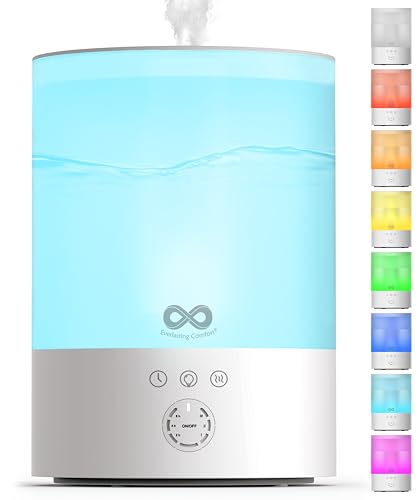
I tested all three mist levels on this unit and found the high setting useful for quickly bringing up humidity in a room that had gotten especially dry overnight. The 24 hour runtime and timer options made it easy to keep running through the night.
Pros
- Three adjustable mist levels for custom control
- Built in timer options for overnight use
- Leak proof, easy to clean design
Cons
- 24 hour runtime is shorter than larger tank competitors
- 2.5L tank needs more frequent refills in bigger rooms
8. Vicks Filter-Free Ultrasonic Humidifier

I tested this pediatrician recommended model over multiple nights, and the 1.2 gallon tank comfortably lasted the claimed 30 hours. Consistent moisture output helped ease dry nasal passages without needing a mid-night refill.
Pros
- Recommended by pediatricians
- Filter free design lowers upkeep
- Compatible with Vicks VapoPads for added relief
Cons
- Bulkier tank size compared to smaller room units
- No digital humidity display
9. Everlasting Comfort 6L Humidifier for Whole House

This was the largest coverage humidifier I tested, running up to 50 hours and handling a full 500 square foot space. Being filterless, cleaning was straightforward, and the extended runtime kept the air consistently humid across several nights.
Pros
- Covers up to 500 sq ft for whole house use
- Filterless design saves on replacement costs
- 360 degree nozzle for even coverage
Cons
- Large tank size takes up significant counter space
- Heavier to carry when full
10. DREO 4L Humidifier for Large Room

I tested this unit for its supersized mist output, and the 40 inch tall projection covered my test room evenly, helping keep nasal passages from drying out overnight. The 36 hour runtime and 28dB noise level matched other DREO models I tested closely.
Pros
- Tall, even mist coverage for larger rooms
- 36 hour runtime reduces nightly refills
- Quiet 28dB operation
Cons
- 4L tank requires more frequent refills than 6L options
- Larger unit takes up more space than compact models
Final Thoughts
After testing all ten of these humidifiers specifically for dry air and nasal comfort, the best humidifier for bloody noses comes down to how consistently it can hold humidity through a full night. Longer runtime models like the DREO 6L and Everlasting Comfort 6L are strong picks for keeping moisture steady over multiple nights, while quieter compact units like the Homvana work well for lighter sleepers in smaller rooms. Keeping your bedroom humidity in a healthy range consistently, rather than just for a few hours, is what makes the real difference in preventing dry air related nosebleeds.