Anyone who has tried cooling a 2000 square foot home with a single window unit already knows how that story ends, with one freezing room and three others still sweltering by mid afternoon. A space this size almost never gets cooled evenly by one appliance alone, whether that appliance is a central system straining to keep up or a single portable unit parked in the living room. After running multiple large capacity units across different zones of a home this size, the real answer to finding the best air conditioner for 2000 square feet usually involves matching the right unit to each zone rather than searching for one machine that magically does it all. Here is my honest breakdown of the strongest options available right now for tackling a home or space in that size range, whether you are cooling zone by zone or supplementing a struggling central system.



Buying Guide: Cooling a 2000 Square Foot Space
The honest starting point for anyone searching for the best air conditioner for 2000 square feet is understanding that no single window or portable unit is built to cool a space this large on its own. Most of the largest consumer window units top out around 1,500 square feet, and portable units generally cap out even lower. For a true 2000 square foot home, a central HVAC system is the standard solution, but many people are working with rentals, older homes without ductwork, or budgets that make a full system replacement unrealistic right now.
Zone cooling is the practical workaround, and it means treating your 2000 square foot space as several smaller zones rather than one giant room. A large 24,000 BTU window unit can handle an open concept living and kitchen area, while smaller 12,000 to 16,000 BTU portable units cover individual bedrooms or home offices. This approach costs more upfront than one central unit but gives you flexibility to only run cooling where people actually are.
BTU capacity should scale with each specific zone rather than the whole house total. A bedroom around 300 to 400 square feet typically needs 8,000 to 12,000 BTU, while an open living area closer to 600 to 800 square feet benefits from 14,000 to 16,000 BTU. Matching capacity too aggressively to a small room wastes energy and can leave the space feeling clammy from short cycling.
Voltage requirements become more important as you move into the largest units. Anything in the 22,000 to 24,000 BTU range often requires a dedicated 230V outlet rather than a standard household 115V outlet, so check your electrical setup before purchasing a unit at that size.
Smart controls and scheduling genuinely matter more in a multi-zone setup than in a single room situation. Being able to control several units from one app, or at least schedule each one independently, makes managing a larger space far less of a hassle than manually adjusting each unit throughout the day.
1. Midea 24,000 BTU Smart Inverter 230V Window Air Conditioner

This is the largest capacity unit on this list and the closest thing to a single room solution for a genuinely large open space, rated to cool up to 1,500 square feet. Inverter technology helps it claim more than 40 percent energy savings compared to the Energy Conservation Standard, which matters significantly at this power level since a unit this size can otherwise become expensive to run continuously. Despite its size, Midea kept noise down to a claimed 48.5 dBA, and smart app control paired with Alexa and Google Assistant support makes scheduling straightforward. Keep in mind this unit requires a dedicated 230V outlet rather than standard household power, so an electrician visit may be necessary before installation.
Pros:
- Largest single unit coverage on this list at up to 1,500 square feet
- Inverter technology claims over 40 percent energy savings
- Smart app and voice assistant control included
- Relatively quiet for its size at 48.5 dBA
Cons:
- Requires a dedicated 230V outlet, not standard household power
- Heaviest unit here at over 98 pounds
2. KoolSiln 16,000 BTU Inverter Portable Air Conditioner

For a large living room or open concept zone without access to a 230V outlet, the KoolSiln portable unit covers up to 800 square feet using an inverter compressor that keeps noise below 40 dB. The 360 degree auto-evaporation system claims to convert 80 percent of excess water into cool air overnight, reducing the maintenance burden that comes with running a portable unit continuously in a larger space. Three functions, cooling, fan, and dehumidifier, cover the basics without unnecessary complexity, and the tool-free setup with an adjustable window bracket makes it a reasonable choice for zones where installing a window unit is not practical.
Pros:
- Covers a substantial 800 square feet on standard household power
- Quiet inverter compressor operates below 40 dB
- Auto-evaporation reduces manual drainage needs
- Tool-free setup with adjustable window bracket
Cons:
- Portable design takes up more floor space than a window unit
- Still requires access to a window for the exhaust hose
3. DOMANKI Inverter 16,000 BTU Portable Air Conditioner
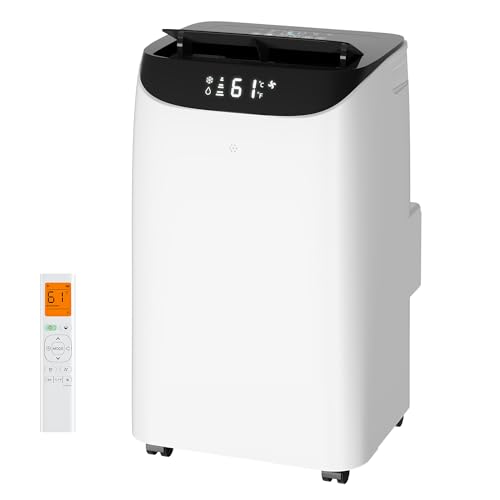
DOMANKI edges out slightly more coverage at up to 850 square feet, making it a strong pick for the largest zone in a 2000 square foot layout that still needs a portable rather than window mounted solution. The inverter compressor claims up to 40 percent energy savings while the dual duct design balances fresh air intake with heat exhaust to prevent outdoor heat from seeping back into the room. Four smart modes, including auto swing between 15 and 75 degrees, help distribute cool air more evenly across a larger footprint than a fixed direction unit would manage. Sleep mode brings noise down to 42 dB, and a child lock adds a useful safety feature for zones near living areas with kids present.
Pros:
- Covers up to 850 square feet, the largest portable option here
- Auto swing between 15 and 75 degrees improves air distribution
- Child lock adds safety for family living spaces
- 42 dB sleep mode with automatic overnight temperature adjustment
Cons:
- Portable footprint requires more floor space than a window unit
- Warranty terms are less detailed than some competitors
4. Temprium 14,000 BTU 4-in-1 Smart AC with WiFi
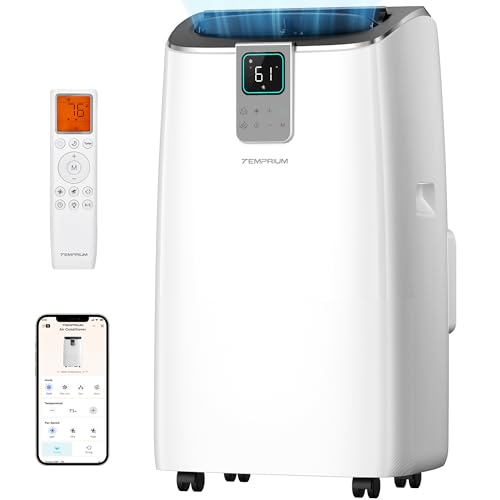
Temprium covers up to 750 square feet with a dual motor compressor and 400 CFM airflow, making it a solid fit for a large bedroom or secondary living space within a bigger home. At just 2 kWh per day and a 7.8 CEER rating, it manages to keep energy costs reasonable even when run for extended stretches. Silent mode brings noise down to a claimed 41 decibels, and the no-drill window kit fits frames from 20.5 to 50 inches, which makes it a flexible option for rental properties where you cannot modify the window frame. Four control methods, app, Alexa, Google Assistant, and remote, give plenty of flexibility for managing this unit as part of a larger multi-zone setup.
Pros:
- Covers up to 750 square feet with strong 400 CFM airflow
- Low energy use at approximately 2 kWh per day
- No-drill window kit works well for rental properties
- Four different control methods for flexible management
Cons:
- Heavier unit at nearly 69 pounds
- CEER rating is lower than some inverter competitors on this list
5. DOMANKI 14,000 BTU Portable Air Conditioner for Room Cooling

This DOMANKI model covers up to 700 square feet and stands out for its genuinely strong dehumidification capacity, rated at 96.2 pints per day, which is a meaningful advantage in humid climates where moisture control matters as much as raw cooling. The built-in auto evaporation system handles condensate automatically in most conditions, only requiring drainage every 8 hours in especially humid basement environments. Sleep mode keeps noise at a claimed 48 dB, and the smart touch panel combined with a 23 foot remote range makes operation accessible even for less tech comfortable household members. Four adjustable fan speeds and a child lock round out a genuinely practical feature set for a secondary zone.
Pros:
- Strong dehumidification capacity at 96.2 pints per day
- Auto evaporation system reduces manual drainage needs
- Remote works from up to 23 feet away
- Child lock included for family friendly use
Cons:
- 48 dB sleep mode is louder than some inverter competitors
- Heavy at 65 pounds, making relocation between zones more effort
6. GrowthWing 14,000 BTU Smart WiFi Portable Air Conditioner

GrowthWing brings a wide 77 degree air outlet and R32 refrigerant to this unit, which the brand rates for up to 550 square feet of steady cooling with a genuinely powerful 12,000 BTU ASHRAE compressor behind it. The standout feature here is the 72 hour auto-evaporation system, which the brand claims provides three full days of drainage-free operation in most environments before any manual intervention is needed. Sleep mode keeps noise at 42 dB with an automatically dimming display, and smart WiFi, voice, and remote control options give flexible management for a zone that does not need constant attention. The adjustable window panels fit a wide range from 20.39 to 67 inches, giving installation flexibility across different room layouts.
Pros:
- Up to 72 hours of drainage-free operation in most conditions
- Wide adjustable window panel fits 20.39 to 67 inch openings
- Smart WiFi, voice, and remote control options
- Quiet 42 dB sleep mode with auto-dimming display
Cons:
- 550 square foot coverage is smaller than some competitors at the same BTU rating
- Best suited for secondary rooms rather than the largest zone in the home
7. Midea 12,000 BTU Window Air Conditioner with Heat

For a bedroom or home office zone that also benefits from supplemental heat during cooler months, this Midea unit covers up to 550 square feet with inverter technology that claims up to 35 percent energy savings compared to the Energy Conservation Standard. The heat pump function works when outside temperatures stay above 41 degrees, making it genuinely useful for fall and spring shoulder seasons rather than deep winter use. Five modes and three speed settings give solid flexibility, and a CEER of 13.3 reflects strong real world efficiency for a window mounted unit at this capacity. Noise stays around 45 dBA, quiet enough for a bedroom without being the standout quietest option on this list.
Pros:
- Includes supplemental heat for shoulder season comfort
- Strong CEER rating of 13.3 for genuine efficiency
- Smart app and voice assistant control included
- Washable front filter simplifies maintenance
Cons:
- Heat pump function stops working below 41 degrees outside
- 550 square foot coverage limits it to a single mid-size room
8. BLACK+DECKER Smart Portable Air Conditioner with Heat, 12,000 BTU

Rounding out this list, the BLACK+DECKER unit covers up to 550 square feet and adds a genuinely useful 10,500 BTU heat function alongside cooling, dehumidifying, and fan modes, making it a flexible four season option for a secondary zone. The Follow Me remote feature lets the remote itself act as a thermostat, sensing the temperature at your actual location rather than wherever the unit happens to sit, which improves comfort accuracy in larger or oddly shaped rooms. Wi-Fi connectivity brings app and voice control through Alexa or Google Assistant, and the included window kit simplifies setup. This is a solid pick for a home office or guest room that needs both cooling in summer and light heating during cooler months without a dedicated space heater.
Pros:
- Includes 10,500 BTU heat for genuine four season use
- Follow Me remote improves temperature accuracy at your actual location
- Wi-Fi enabled with app and voice assistant control
- Full four-in-one function covering cooling, heat, dehumidify, and fan
Cons:
- 550 square foot coverage limits it to a single mid-size zone
- Heavier than comparable cooling-only portable units at nearly 60 pounds
Cooling a full 2000 square foot space realistically means combining several of these units across different zones rather than expecting one machine to do the entire job. The Midea 24,000 BTU window unit is the strongest single option for a large open living area, while the 14,000 to 16,000 BTU portable units on this list work well distributed across bedrooms and secondary rooms. Whichever combination you choose, matching each unit’s coverage to its specific zone rather than the whole house total will give you far more consistent comfort than relying on one oversized unit alone.