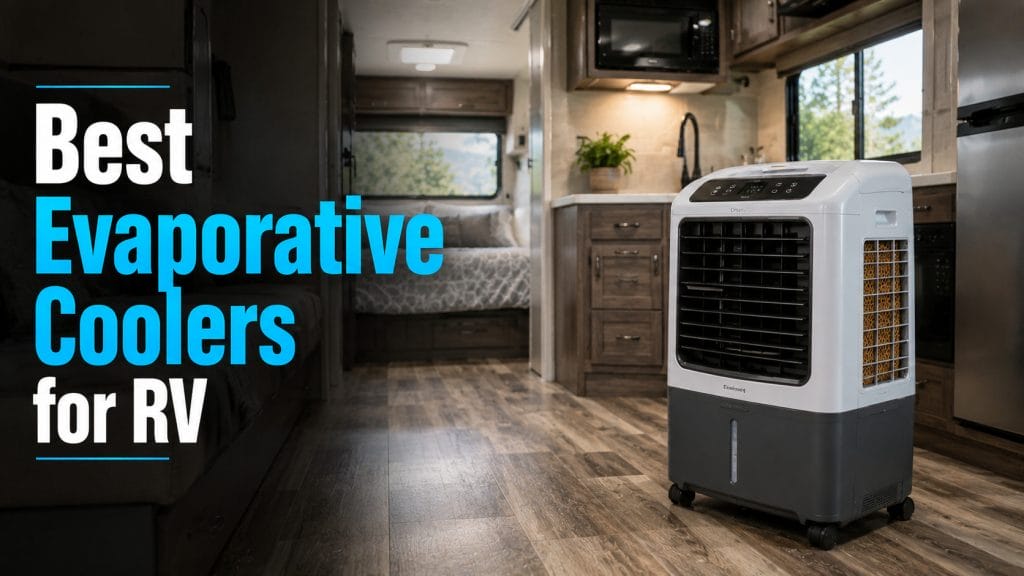
Running the roof AC in an RV while dry camping without hookups drains a battery bank fast, and that reality is exactly why evaporative coolers have become such a popular add-on for RV owners who spend time in dry climates. After running several of these units through actual RV trips, from a small teardrop trailer to a larger travel trailer parked for a week at a time, I found that size, power draw, and how well the unit handles RV-specific constraints like limited floor space and shore power access mattered far more than raw CFM numbers alone. Here is my honest breakdown of the best evaporative coolers for RV use in 2026, covering everything from compact bedside units to larger coolers suited for bigger rigs with reliable power access.



Buying Guide: Choosing an Evaporative Cooler for an RV
Evaporative cooling depends entirely on dry conditions to work well, which actually makes it a natural fit for RV travel since many of the most popular dry camping destinations, the Southwest, Texas, and the desert states, are exactly where this technology performs best. If your travels take you through humid regions, expect significantly reduced performance and plan on your RV’s built-in roof AC for those stretches instead.
Power draw matters more in an RV than almost any other setting, since you are often working with a limited battery bank, a small generator, or shore power that you want to reserve for other appliances. Most compact evaporative coolers in this category run between 60 and 110 watts, which is genuinely light compared to a roof AC unit’s draw, making them a reasonable option for boondocking when paired with a solar setup or a modest battery bank.
Floor space inside an RV is almost always at a premium, so physical footprint deserves real consideration before buying. A large floor-standing unit with an 18 gallon tank might work well in a bigger fifth wheel or travel trailer, but it could easily dominate the living space in a smaller camper van or teardrop trailer.
Water tank size determines how often you refill during a trip, and this becomes a genuine hassle multiplier when you are also managing a limited fresh water supply for drinking, cooking, and washing. Smaller tanks in the 1 to 3 gallon range are more practical for RVs where fresh water itself is a limited resource, while larger tanks make more sense if you have easy access to a hose bib at a campground.
No installation requirement is a genuine advantage of evaporative coolers over compressor based portable ACs in an RV setting, since you avoid cutting a hole for an exhaust hose or dealing with a window kit that may not fit RV window frames properly.
1. ZephyMyth 2026 Upgraded 4-in-1 Quiet Portable AC Unit

ZephyMyth explicitly designs this unit with RV use in mind, and its compact 6.5 by 5.5 by 10.5 inch footprint genuinely fits the tight counter or dinette space typical of most RVs. Two operating modes, Natural Wind for water-free operation and Cooling Mode for when you add water or ice, give flexibility depending on whether you want simple air movement or active evaporative cooling. The tank supports up to 8 hours of continuous mist, and USB power means it can run off a power bank, laptop, or vehicle charger, genuinely useful when boondocking away from shore power. At just 2.86 pounds, it is easy to stash away when driving between campsites.
Pros:
- Explicitly designed with RV and car use in mind
- Compact footprint fits tight RV counter or dinette spaces
- USB powered for flexible charging options while boondocking
- Lightweight and easy to stow while driving
Cons:
- Smaller tank means more frequent refills than larger units
- Limited to close personal range rather than cooling a full RV interior
2. Anliclix Upgraded Evaporative Air Cooler
For bedside cooling in an RV sleeping area, the Anliclix unit offers nine total combinations across three wind speeds and three mist modes, giving genuine control over exactly how much cooling and moisture you want overnight. The 1200ml tank supports continuous misting with automatic switchover to fan-only once water runs dry, and 120 degree adjustable shutters let you direct airflow precisely toward a bunk or bed. No hose or assembly is required, making it truly plug and play for RV use, and the aromatherapy pad adds a pleasant touch for a small sleeping nook.
Pros:
- Nine total speed and mist combinations for precise bedside control
- Compact size fits easily on an RV nightstand or shelf
- No hose or assembly required for setup
- Aromatherapy pad adds a relaxing touch to small sleeping areas
Cons:
- 2 to 8 hour timer maximum may be short for some overnight trips
- Cools only the immediate sleeping area, not the whole RV
3. PNTCK 3-in-1 Swamp Cooler with 2.1 Gallon Water Tank

PNTCK strikes a genuinely useful middle ground for RV use, with a 2.1 gallon tank that extends runtime well beyond the smaller personal units while still remaining compact enough for a camper’s living area. The bottom-mounted tank with a visible water level window makes monitoring simple, and two included ice packs boost cooling performance during the hottest parts of the day. A child lock feature adds real value for families traveling with kids in a small shared space, and four universal casters combined with a built-in handle make it easy to reposition between the dinette and sleeping area as needed throughout the day.
Pros:
- 2.1 gallon tank balances runtime with a manageable footprint
- Child lock adds safety for families traveling with kids
- Includes two ice packs for enhanced cooling
- Casters and handle make repositioning within the RV simple
Cons:
- Still requires refilling during longer stretches away from a water source
- 12-hour timer maximum means overnight trips may need a mid-sleep restart
4. CENSTECH Windowless Air Conditioner Portable 1800CFM

CENSTECH’s windowless design is a genuine advantage for RV use, since it requires no exhaust hose or window kit that would otherwise need to fit an RV’s often non-standard window dimensions. The 3-gallon tank paired with 1800 CFM airflow covers up to 600 square feet, more than enough for most RV interiors, and 120 degree horizontal oscillation with 20 degree vertical tilt spreads air evenly rather than concentrating it in one spot. Four included leak-proof ice packs boost cooling beyond what water alone delivers, and sleep mode brings noise down to a claimed 25 dB, quiet enough for an RV bedroom at the back of the rig.
Pros:
- Windowless design avoids RV window fitting issues entirely
- 3-gallon tank covers most RV interiors for up to 24 hours
- Includes four reusable ice packs for extra cooling power
- Sleep mode runs at a claimed 25 dB for quiet overnight use
Cons:
- Larger footprint than smaller personal coolers on this list
- Best performance requires genuinely dry outdoor conditions
5. Beautyfan Evaporative Air Cooler with 10 Gallon Water Tank

Beautyfan specifically lists RV use among its intended applications, and the 10-gallon tank is a genuine advantage for extended dry camping stretches where refilling from a limited fresh water tank is a real hassle you want to minimize. A claimed 30 hours of continuous cooling per fill means you could realistically run this for several days between refills depending on usage. The fully removable tank design simplifies cleaning, which matters for avoiding odor buildup in a space as enclosed as an RV interior, and 120 degree wide-angle oscillation spreads cool, moist air evenly through the cabin. At a claimed 30 dB, it stays quiet enough for RV sleeping quarters.
Pros:
- Explicitly marketed for RV use with a genuinely large tank
- Up to 30 hours of cooling per fill reduces refill frequency
- Fully removable tank simplifies cleaning in a tight space
- Whisper quiet at a claimed 30 dB
Cons:
- Large tank means a bulkier footprint for smaller RV floor plans
- Performs best only in dry climates
6. Ashihoti 4-in-1 Portable Air Conditioner Swamp Cooler

Ashihoti’s installation-free design is a genuine fit for RV use, since it requires no drilling, pipe connections, or window restrictions, ready to use the moment you place it inside your rig. A 3-gallon tank supports up to 12 hours of continuous cooling, and the top-fill design lets you add water quickly without having to move the unit around a cramped RV interior. Six wind speeds paired with three modes give solid customization, accessible either through the touch panel or a 16 foot remote, useful for adjusting settings from a bed or dinette bench without getting up. The 12-hour smart timer helps manage battery or generator use by ensuring the unit does not run longer than intended while you are away from the rig.
Pros:
- Installation-free design ideal for RV interiors
- 3-gallon tank with convenient top-fill access
- Six wind speeds and three modes for fine control
- 12-hour smart timer helps manage power use
Cons:
- 200 square foot coverage rating is modest for larger motorhomes
- Touch panel controls may be less intuitive than simple dial controls for some users
7. Hessaire MC18M 1,300 CFM Portable Swamp Cooler
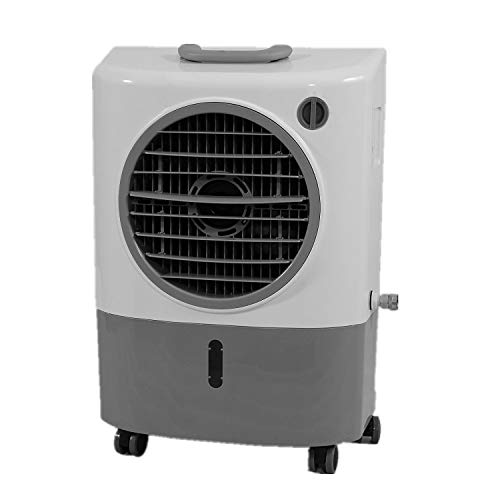
Hessaire brings established credibility to the RV cooling category, having built evaporative cooling equipment since 1996, and the MC18M’s more modest 1,300 CFM rating and 4.8 gallon tank make it a genuinely well-sized option for a mid-size RV rather than an oversized unit better suited to a garage. The hi-density XeL50 media expands the air intake area, and Hessaire claims up to 50 percent electricity savings compared to less efficient competitors. Setup follows the same simple formula found across the Hessaire lineup, fill the tank, connect power, flip the switch, and lightweight ABS resin construction keeps the unit manageable to move between a storage bay and the living area.
Pros:
- Established brand with nearly three decades of evaporative cooling experience
- 1,300 CFM and 4.8 gallon tank sized appropriately for mid-size RVs
- Claims up to 50 percent electricity savings versus less efficient units
- Lightweight ABS construction is easy to move and store
Cons:
- Smaller CFM output than the larger units on this list, better suited to modest RV interiors
- Single cooling pad may need more frequent cleaning than multi-pad designs
8. Manastin 4000CFM Swamp Cooler with 18.4 Gallon Water Tank

For larger motorhomes, fifth wheels, or anyone parked at a campground with reliable shore power and hose access, the Manastin unit represents the high end of this list with a massive 18.4 gallon tank claimed to deliver up to 7 days of continuous cooling. A 120 degree wide airflow pattern covers up to 1500 square feet, far beyond what most RV interiors actually need, making this more appropriate for a larger rig combined with an awning or screen room area outside. Four included ice packs boost cooling further, and the 12-hour smart timer helps manage runtime without requiring constant manual adjustment. This is genuinely overkill for a smaller camper, but a strong fit for extended stays in a larger rig where floor space and water access are less of a constraint.
Pros:
- Massive 18.4 gallon tank claims up to 7 days of continuous cooling
- Covers up to 1500 square feet, useful for larger rigs plus outdoor living space
- Includes four ice packs for enhanced cooling performance
- 12-hour smart timer simplifies runtime management
Cons:
- Large footprint is impractical for smaller campers or teardrop trailers
- Best suited to campgrounds with shore power and easy water refill access
Choosing the right evaporative cooler for your RV really comes down to matching tank size and footprint to both your rig size and how you camp. For smaller campers, teardrops, or bedside use in any RV, the ZephyMyth, Anliclix, or PNTCK units keep things compact and manageable, while the CENSTECH and Beautyfan units strike a solid middle ground for most travel trailers. If you have a larger motorhome and access to shore power and water hookups, the Hessaire and Manastin units deliver genuinely stronger cooling for the investment. Whichever size you choose, remember that dry camping in humid regions will limit performance regardless of the unit, so plan your evaporative cooler as a genuine power-saving supplement to your RV’s roof AC rather than a full replacement.