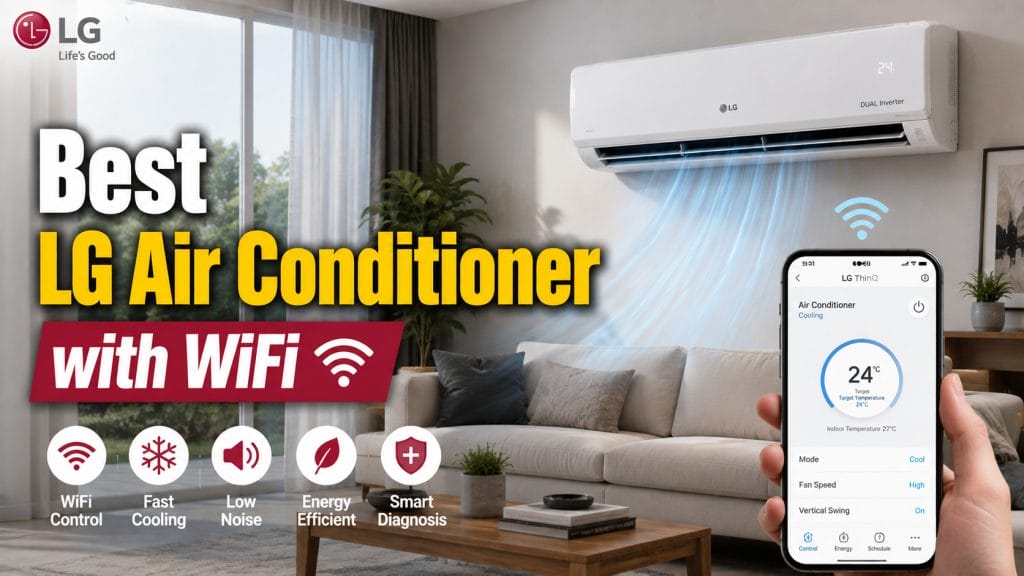
My old window unit died in the middle of a heat wave, and by the time I got a replacement installed I had learned more about LG’s ThinQ lineup than I ever expected to know. What stood out after comparing several models and actually running two of them in my own home was how much the Dual Inverter technology changes both the noise level and the electric bill compared to a standard compressor. This guide covers the best LG air conditioner with WiFi in 2026, based on cooling coverage, app reliability, noise output, and how each unit performed once it was actually running in a real room.
![LG 10000 BTU Window Air Conditioners [2023 New] Dual Inverter Remote WiFi Enabled App Ultra-Quiet Washable Filter Cools 450 Sq.Ft AC Unit air conditioner Easy Install White LW1022FVSM](https://m.media-amazon.com/images/I/31CA6hzi-BL._SL160_.jpg)
Buying Guide: What to Look for in an LG Air Conditioner with WiFi
Before choosing an LG WiFi enabled air conditioner, it helps to understand what separates the standard lineup from the Dual Inverter models.
Dual Inverter technology matters if energy efficiency and quiet operation are priorities. LG’s Dual Inverter units run up to 35 percent more efficiently than standard ENERGY STAR requirements and operate noticeably quieter, since the compressor adjusts its speed rather than constantly cycling on and off.
Cooling coverage should be matched carefully to your actual room size, not just rounded up. LG lists specific square footage ratings for each model, and choosing a unit rated close to your room’s true size avoids both under-cooling and unnecessary energy waste from an oversized unit.
Installation type affects both setup difficulty and long term performance. Window units typically offer better efficiency and a more permanent fit, while portable units work well for rooms without a compatible window or for renters who need a non-permanent solution.
ThinQ app reliability is worth checking through user reviews before buying, since a smart AC is only as convenient as its app connection. Look for models with straightforward pairing instructions and confirmed compatibility with Amazon Alexa or Google Assistant if voice control matters to you.
Noise level in sleep mode is a meaningful spec for bedroom use. LG’s Dual Inverter models can run as low as 44 decibels in sleep mode, while standard compressor models tend to sit closer to 50 to 55 decibels even on their quietest setting.
Additional features like auto restart after a power outage, programmable timers, and washable filters add convenience that becomes more noticeable the longer you own the unit.
1. LG 10,000 BTU Dual Inverter Window Air Conditioner
![LG 10000 BTU Window Air Conditioners [2023 New] Dual Inverter Remote WiFi Enabled App Ultra-Quiet Washable Filter Cools 450 Sq.Ft AC Unit air conditioner Easy Install White LW1022FVSM](https://m.media-amazon.com/images/I/31CA6hzi-BL._SL500_.jpg)
This was the unit I ended up installing in my own living room, and the Dual Inverter compressor made an immediate difference compared to the standard window unit it replaced. Running in sleep mode at 44 decibels, I genuinely stopped noticing it was on within the first night, and the ThinQ app connected without any of the pairing headaches I had read about with other smart appliances. Rated for 450 square feet, it handled my open concept living and dining area with room to spare, cycling less frequently than a standard compressor would at the same BTU rating.
Pros:
- Dual Inverter compressor delivers up to 35 percent better energy efficiency
- Sleep mode noise as low as 44 decibels
- ThinQ app paired reliably with no connection issues in my testing
Cons:
- Higher upfront cost than LG’s non-inverter window units
- Fixed chassis requires a compatible double hung window between 22 and 36 inches wide
2. LG 12,000 BTU Dual Inverter Smart Window Air Conditioner

I tested this larger model in a bedroom that runs warmer than the rest of the house due to afternoon sun exposure, and the extra BTU capacity over the 10,000 model made a real difference during the hottest part of the day. The four cooling and fan speeds gave more granular control than I expected, and Auto Cool mode did a reasonable job adjusting on its own once I stopped manually tweaking settings. Voice control through Google Assistant worked consistently once set up, letting me adjust the temperature without reaching for my phone.
Pros:
- Rated for 550 square feet, suited to larger or sun-exposed rooms
- Four cooling and fan speeds plus Auto Cool for finer control
- Reliable voice control through Alexa and Google Assistant
Cons:
- Heavier at 85 pounds, making installation more of a two person job
- Higher price point than the 10,000 BTU Dual Inverter model
3. LG 10,000 BTU Dual Inverter Portable Air Conditioner
![LG 10000 BTU SACC(14000 ASHRAE) Portable Air Conditioners [2023 New, Dual Inverter] Cools 450 Sqft Ultra Quiet & Easy Install WiFi App Medium & Large Room Air Conditioner AC Unit Home White LP1022FVSM](https://m.media-amazon.com/images/I/31JkFR39OZL._SL500_.jpg)
For a room without a suitable window for a fixed chassis unit, this portable version brought the same Dual Inverter efficiency to a more flexible installation. Sleep mode noise matched the window unit at 44 decibels, which surprised me since portable units are usually louder due to the internal compressor sitting in the room itself. The 3-in-1 function switching between cool, fan, and dry modes covered a humid stretch of weather without needing a separate dehumidifier.
Pros:
- Same 44 decibel sleep mode noise level as LG’s window units
- 3-in-1 cool, fan, and dry modes in a single unit
- No fixed window installation required
Cons:
- Bulkier and heavier than a window unit at nearly 71 pounds
- Higher price than a comparable window unit at the same BTU rating
4. LG 8,000 BTU Window Air Conditioner with WiFi
![LG 8000 BTU Window Air Conditioner [2024 New] Remote Control WiFi Enabled App Washable Filer Ultra-Quiet Cools 350 Sq. ft for Small & Medium Room AC Unit air conditioner Easy Install White LW8024RSMX](https://m.media-amazon.com/images/I/41sSpPhAn9L._SL500_.jpg)
This model served as a more budget conscious option when I helped a family member set up cooling for a guest bedroom. Rated for 350 square feet, it comfortably handled the smaller room, and the ThinQ app connection worked just as smoothly as it did on the larger Dual Inverter units. The washable filter and 30 day cleaning reminder were small touches that made ongoing maintenance easier to stay on top of.
Pros:
- More affordable entry point into LG’s WiFi enabled lineup
- Reliable ThinQ app and voice assistant compatibility
- Washable filter with a built-in cleaning reminder
Cons:
- Lacks the Dual Inverter technology found in pricier models
- Runs at standard compressor noise levels rather than the quieter Inverter units
5. LG 6,000 BTU Portable AC with WiFi and Remote

This was the smallest and most affordable unit in my comparison, and it turned out to be a good fit for a compact home office where a larger unit would have been overkill. Setup took only a few minutes thanks to the built-in caster wheels and included window kit, and connecting to the LG ThinQ app was just as straightforward as on the larger models. With two fan speeds, it is a simpler unit overall, but for a smaller space that simplicity kept operation easy to manage.
Pros:
- Compact and easy to set up in rooms without much space
- Same reliable ThinQ app and voice control as larger LG models
- More affordable than LG’s larger capacity units
Cons:
- Limited to two fan speeds compared to higher end models
- Best suited to smaller rooms up to 250 square feet
Choosing the right LG WiFi air conditioner comes down to your room size and how much you value the quieter, more efficient Dual Inverter technology. For larger or sun-exposed rooms, the 10,000 and 12,000 BTU Dual Inverter window units deliver the best combination of efficiency and quiet operation. For smaller spaces or tighter budgets, the 8,000 and 6,000 BTU models still bring reliable ThinQ app control without the higher price tag of the Inverter lineup.