
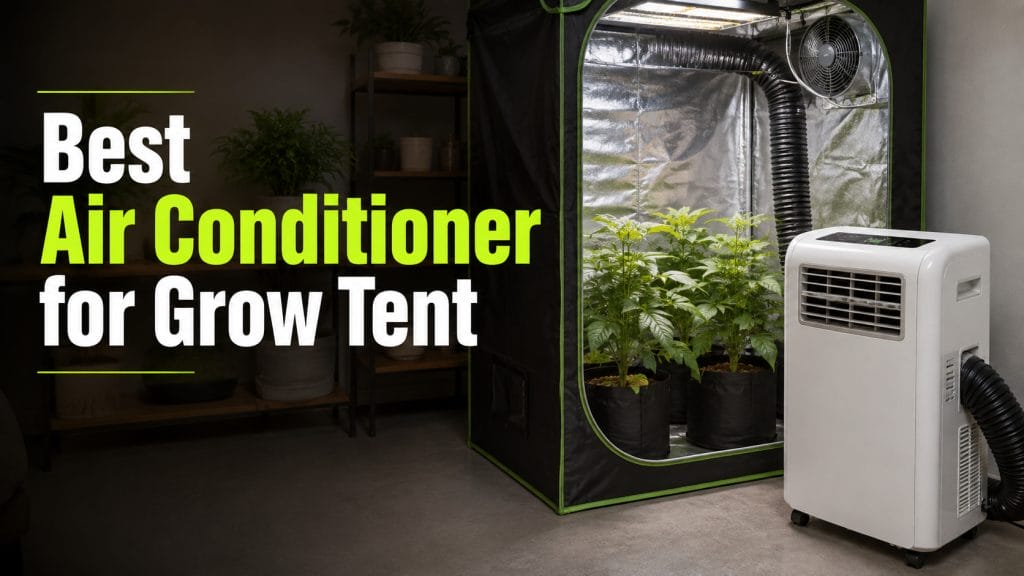
Grow lights throw off a surprising amount of heat, and once you pack a few hundred watts of LED into a sealed tent, temperature control stops being optional. After running several cooling setups through a full grow cycle and comparing purpose-built plant air conditioners against generic ducted units repurposed for tent use, I put together this list of the best air conditioner for grow tent applications in 2026. Some of these are designed specifically for cultivation, while others are standard portable units that vent cleanly through a tent port and hold up well under continuous use. Here is what actually worked, with real specs and honest pros and cons for each.


Buying Guide: How to Choose an Air Conditioner for a Grow Tent
Cooling a grow tent is different from cooling a bedroom, mainly because the heat load comes from lights running on a fixed schedule rather than ambient weather. Here is what to think through before buying.
Match BTU to your light wattage and tent size, not just square footage. A tent with a 600 watt LED will run hotter than an empty room of the same size. As a rough guide, plan for more cooling capacity than a standard room calculator suggests, especially in a sealed tent with limited airflow.
Decide between a purpose-built plant AC and a generic ducted unit. Dedicated grow tent air conditioners often include VPD and humidity sensors tuned for plant health, along with app integration for grow automation. Generic portable ACs cost less and still work well when vented through a duct port, but they are built around comfort cooling rather than plant science.
Check the venting setup. Most units here use a single hose to exhaust hot air, which is simpler to install through a tent’s duct port but pulls some conditioned air out with it. If your tent already runs an exhaust fan, coordinate the two so they are not fighting each other.
Look for drainage-free or self-evaporating operation. A tent is a bad place for a water tray to overflow. Self-evaporating systems reduce how often you need to manually drain condensate, which matters a lot in an enclosed grow space you may not check daily.
Consider noise and placement. Compressor units are not silent, so if the tent shares a room with living space, check the decibel rating and plan on running the unit outside the tent with just the duct connected inside when possible.
Factor in humidity control. Cooling and dehumidifying often need to work together in a grow tent, since lowering temperature without managing humidity can invite mold. Units with a dedicated dry mode, or a separate dehumidifier paired with your AC, give you more control over the full environment.
1. VIVOSUN AeroLush C08 8000BTU Smart Air Conditioner for Grow Tents

This is one of the few units on the market actually engineered for grow tents rather than adapted for them. It runs an 8000 BTU compressor with Sensirion sensors for real-time temperature, humidity, and VPD monitoring, plus four modes covering cooling, drying, heating, and fan-only operation. The Vivosun app allows remote monitoring and custom timer schedules, and it is recommended for tents up to 5×5 feet.
Pros:
- Built-in VPD and humidity sensors made specifically for plant environments
- Four operating modes cover cooling, drying, and heating in one unit
- Self-evaporating design with auto-restart after power outages
Cons:
- Recommended tent size caps out at 5×5 feet
- Performance can dip at higher duct fan speeds, so tuning is needed
2. AC Infinity TERRAFORM 8, 5-in-1 Plant Air Conditioner

The TERRAFORM 8 is a true single-duct plant air conditioner that uses dynamic AI to self-regulate the grow environment. Set a target temperature or VPD, and the system automatically switches between cool, heat, and fan modes to hold it. It connects with AC Infinity’s Controller AI+ for advanced automation, data tracking, and alerts, and the self-evaporative design reduces manual draining.
Pros:
- Auto-switching between cool, heat, and fan based on your VPD target
- Deep integration with AC Infinity’s controller ecosystem for automation
- Self-evaporative design pumps excess water to the condenser automatically
Cons:
- Drying function requires manual two-duct adjustment rather than one-touch operation
- At over 70 pounds, this is not a unit you will reposition often
3. Cybertake S2 Pro Portable Camping Air Conditioner
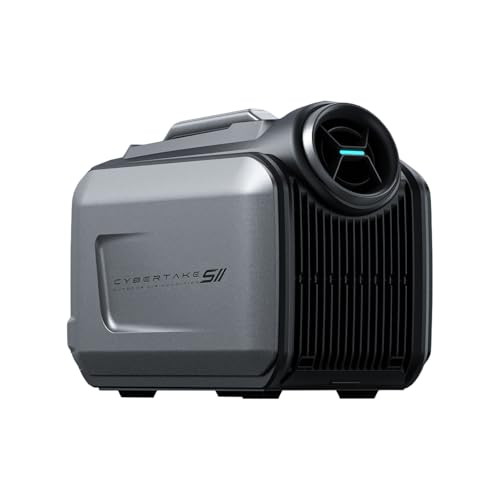
Built for tents, RVs, and cabins rather than plants specifically, the S2 Pro delivers 5100 BTU of cooling and 6100 BTU of heating with three power options including a wall outlet, 12-24V vehicle power, or a 48V DC power station. Eco+ mode uses as little as 1kWh per 8 hours, and it includes a 0 to 12 hour timer with three fan speeds.
Pros:
- Runs on three different power sources for flexible setups
- Eco+ mode keeps energy use low during extended operation
- Rated at a whisper-quiet 40dB
Cons:
- Rated for spaces up to 130 square feet, which suits smaller tents best
- Remote control and boost converter are sold separately
4. Outohome Portable Camping Air Conditioner

This compact camping AC uses a GMCC compressor rated at 5200 BTU and can drop ambient temperature by 18°F within five minutes. It includes cooling, dehumidifying, sleep, and fan modes, a 24 hour timer, and drainage-free operation when humidity stays below 70 percent, with a drain pipe included for wetter conditions.
Pros:
- Fast initial cooling, rated to drop temperature within five minutes
- Drainage-free operation under normal humidity levels
- Compact at just under 32 pounds with a single-hand carry grip
Cons:
- Best suited to smaller tents given its 5200 BTU rating
- Drain pipe setup becomes necessary once humidity climbs above 70 percent
5. BLACK+DECKER 10,000 BTU Portable Air Conditioner

A generic portable AC that works well ducted into a grow tent when floor space allows for a full-size unit outside the tent. It combines cooling, dehumidifying, and fan modes, a Follow Me remote that acts as a thermostat, and an included window installation kit that can be adapted to a duct port setup.
Pros:
- Rated for up to 450 square feet, more capacity than most tent-specific units
- Follow Me remote allows precise temperature targeting
- Casters and side handles make repositioning easier
Cons:
- Not designed with plant humidity or VPD monitoring in mind
- At over 47 pounds, it needs floor space outside the tent
6. Garvee 8,000 BTU Portable Air Conditioner

Garvee’s 3-in-1 unit covers up to 350 square feet with cool, dehumidifier, and fan modes, a 1 to 24 hour timer, and quiet operation under 51dB. The included window kit fits openings from 15.47 to 47.24 inches, and the self-evaporating system cuts down on manual draining.
Pros:
- Full 1 to 24 hour programmable timer for flexible scheduling
- Quiet operation rated under 51dB
- Self-evaporating system reduces manual drainage needs
Cons:
- Not purpose-built for grow tents, so no VPD or plant-specific monitoring
- Window kit may need trimming for smaller window openings
7. BLACK+DECKER 9,000 BTU Portable Air Conditioner

A step down in capacity from the 10,000 BTU model, this unit still covers up to 400 square feet with the same Follow Me remote thermostat feature and three-in-one cooling, dehumidifying, and fan functionality. Casters and side handles make it easy to move between a grow room and other spaces.
Pros:
- Follow Me remote thermostat function for accurate temperature control
- Easy mobility with casters and side handles
- Simple window installation kit included
Cons:
- Sized for general room use rather than tent-specific ducting
- Heavier unit at nearly 53 pounds
8. Midea 8,500 BTU Portable Air Conditioner

This Midea model is rated for spaces up to 150 square feet, which lines up well with smaller and mid-size grow tents. It includes app and voice control through Alexa or Google Assistant, a 24 hour adjustable timer, and a washable air filter for ongoing maintenance.
Pros:
- Compact 150 square foot rating fits smaller grow tents well
- App and voice control add scheduling flexibility
- Washable, reusable air filter is easy to maintain
Cons:
- Lower BTU rating may struggle with high-wattage lighting setups
- Limited stock availability at times
9. DREO Portable Air Conditioner 318S

DREO’s 318S pairs an 8000 BTU rating with a true drainage-free system using sensors and a pump to automatically evaporate excess water below 90 percent humidity. App, voice, and remote control are all supported, and DREO’s noise isolation system brings compressor noise down to 45dB.
Pros:
- True drainage-free operation up to 90 percent humidity
- Noise isolation system rated at 45dB
- Sleep curve customization through the DREO app
Cons:
- Drain hose still required in very high humidity environments
- At 55 pounds, it is on the heavier side for repositioning
10. Midea 9,000 BTU Portable Air Conditioner
A slightly larger Midea model rated for up to 250 square feet, useful if you are cooling more than one tent or a shared grow space. It keeps the same SmartHome app control, 24 hour adjustable timer, and washable filter as the smaller model in this lineup.
Pros:
- 250 square foot rating covers larger or multiple tent setups
- SmartHome app supports scheduling and remote adjustments
- Consistent washable filter design for easy upkeep
Cons:
- Not designed with plant-specific sensors or VPD tracking
- Window kit installation still required for exhaust venting
11. Midea 10,000 BTU Portable Air Conditioner
The largest Midea model in this list covers up to 300 square feet, giving it enough headroom for bigger tents or rooms with more than one light running. It shares the same 24 hour timer, app and voice control, and washable filter found across the Midea lineup.
Pros:
- Highest capacity Midea option here at 300 square feet
- Consistent smart control features across the Midea line
- Easy installation with an included window kit and hose
Cons:
- Larger unit at just over 50 pounds
- No dedicated plant monitoring features
12. GrowthWing 14,000 BTU Smart WiFi Portable Air Conditioner

The most powerful unit in this roundup, GrowthWing is rated for spaces up to 550 square feet, making it a good fit for larger grow rooms with multiple tents. It offers a 72 hour drainage-free auto-evaporation system, a 42dB sleep mode, and WiFi, voice, and remote control through one app.
Pros:
- Highest BTU rating in this list at 14,000
- 72 hour drainage-free operation reduces maintenance
- Quiet sleep mode rated at 42dB
Cons:
- Sized for larger spaces, likely more capacity than a single small tent needs
- At 66 pounds, this is the heaviest unit on the list
Final Thoughts
If your priority is plant-specific monitoring and hands-off automation, the VIVOSUN and AC Infinity units are the strongest picks here since they are built around VPD and humidity data rather than adapted from home cooling. If you are working with a smaller tent or tighter budget, the compact camping style units from Cybertake and Outohome hold up well and are easier to move around. For anyone cooling a larger tent or a shared grow space, the higher capacity Midea, DREO, and GrowthWing units give you more room to work with, as long as you plan for their size and weight. Match the BTU rating to your actual light load rather than tent square footage alone, and you will avoid the most common mistake people make when cooling a grow tent for the first time.