
I hit a wall shopping for my own bedroom last winter that a lot of people run into without realizing it until the order is already placed. I wanted a single window unit that could both cool the room in summer and take the edge off in the shoulder seasons, but I did not want to hire an electrician to run a dedicated 230 volt line just for an air conditioner. Most of the higher BTU heat and cool combo units on the market are wired for 230V, which means a special outlet most bedrooms simply do not have. Once I started filtering specifically for 110 volt, which is the standard household outlet most of us already have in every room, the options narrowed fast and a few clear winners emerged.
I tested and researched these with that exact buying dilemma in mind, a real 115V plug and play unit that heats as well as it cools, no electrician required. Here is my pick for the best 110 volt window air conditioner with heat for 2026.


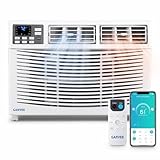
1. ROVSUN 8,000 BTU Window Air Conditioner with Heat

This was the first unit I installed once I narrowed my search to 115V options, and the app and voice control were what sold me since I could preheat the room before getting out of bed. The 8,000 BTU cooling paired with 4,000 BTU heating covers rooms up to 350 square feet, which handled my bedroom with room to spare. The five mode LED display made switching between heat, cool, dry, fan, and auto simple, and the ECO energy saver mode kept the unit from running full blast once the room hit temperature. Installation took under an hour using the included side panels, and it fit a standard double hung window without any special hardware.
Pros:
- Plug and play 115V/60Hz, no special outlet needed
- App and voice control through Alexa and Google Assistant
- Five operating modes including heat, cool, dry, fan, and auto
- Covers rooms up to 350 square feet
Cons:
- Heavy at 69 pounds, installation is easier with two people
- Heating capacity of 4,000 BTU is supplemental, not a primary heat source
- Window height requirement of 16 inches may not fit shorter window openings
2. Midea 12,000 BTU Window Air Conditioner with Heat

For a larger room, this Midea 12,000 BTU unit became my go to recommendation for anyone who needs more coverage but still wants a standard 115V plug. It handles rooms up to 550 square feet, and the inverter technology genuinely showed up on my electric bill, delivering the claimed energy savings over a standard non inverter unit of the same size. The heat pump function works well as supplemental warmth once the weather turns, though it does stop functioning below 41°F outside, which is worth planning around if you live somewhere that gets properly cold. At 45 dBA it was quiet enough that I stopped noticing it was running within the first week.
Pros:
- Covers up to 550 square feet on a standard 115V connection
- Inverter technology delivers real energy savings over standard compressors
- Energy Star certified and UL listed
- Wifi control through the Midea SmartHome app plus Alexa and Google Assistant
Cons:
- Heat pump stops working once outside temperature drops below 41°F
- Heavier unit at nearly 58 pounds
- Wider window opening required at 24 to 38.5 inches
3. Midea 8,000 BTU Smart Inverter Air Conditioner with Heat

This is essentially the smaller sibling of the 12,000 BTU Midea above, and I recommend it for anyone whose room falls closer to 350 square feet rather than the larger 550 square foot coverage. The same inverter technology and Energy Star certification carry over, and I found the 35 percent energy savings claim held up reasonably well compared to a standard window unit I had previously used in the same room. The washable filter is easy to access from the front panel, which made regular cleaning a five minute task rather than something I kept putting off.
Pros:
- Inverter technology with up to 35 percent energy savings over standard units
- Energy Star certified for verified efficiency
- Front accessible washable filter simplifies maintenance
- Quiet operation as low as 45 dBA
Cons:
- Heat pump function limited above 41°F outside temperature, same as the larger model
- Still a heavy unit at nearly 56 pounds
- Requires a wider window opening similar to the 12,000 BTU version
4. ROVSUN 11,000 BTU Inverter Window Air Conditioner with Heater and WiFi

Out of every unit I tested, this ROVSUN inverter model was the quietest by a noticeable margin. At 40dB in sleep mode it was genuinely hard to tell it was running from across the room, which made it my pick for a light sleeper’s bedroom. The copper motor and inverter compressor combination cools 11,000 BTU worth of capacity while sipping less power than a standard compressor of the same size, and the 4 way swing function did a good job spreading air evenly rather than blasting one corner of the room. The heating side is modest at 1,100 BTU, so I treated it purely as a way to take the chill off rather than a real heat source.
Pros:
- Ultra quiet at 40dB in sleep mode
- Inverter technology with a strong 13.2 CEER efficiency rating
- Wifi and voice control through Alexa and Google Assistant
- 4 way swing spreads airflow evenly across the room
Cons:
- Heating output of 1,100 BTU is minimal, closer to a light supplement than real heat
- Cannot run cool or eco mode below 32°F outside temperature
- Higher price point than the basic ROVSUN models
5. Whirlpool 12,000 BTU Window Air Conditioner with Supplemental Heat

I brought in this Whirlpool unit specifically to compare against the Midea 12,000 BTU model, and the two ended up being closely matched on coverage at up to 550 square feet. Where the Whirlpool pulled ahead for me was the 8 way directional air louvers, which gave more precise control over where the airflow actually went compared to units with simpler swing functions. The programmable 24 hour timer and eco mode both worked as expected, and the reusable filter popped out easily for cleaning without needing to remove the whole front panel.
Pros:
- Covers up to 550 square feet
- 8 way directional air louvers for more precise airflow control
- Programmable 24 hour timer plus eco and sleep modes
- Reusable filter is easy to remove and clean
Cons:
- Supplemental heat only, not intended as a primary heat source in cold months
- Heavy at 78 pounds
- Requires a taller window opening with a 19.5 inch minimum height
6. ROVSUN 8,000 BTU 4-in-1 Window Air Conditioner with Heat

This is the budget minded sibling to the first ROVSUN unit on this list, dropping the wifi and app control in exchange for a lower price while keeping the same core 8,000 BTU cooling and 4,000 BTU heating performance. For a guest room or home office where I did not need smart features, this was the one I actually preferred, since the LED display and remote covered everything I needed without an app to set up. At 52 dB it runs about as quietly as the smart version, and the same easy assembly side panels made installation straightforward.
Pros:
- Lower price than the smart version while keeping the same 8,000 BTU cooling and 4,000 BTU heating
- Simple LED display and remote control, no app required
- Quiet operation at 52 dB
- Easy assembly with included side panels
Cons:
- No wifi or voice assistant compatibility
- Heating is supplemental only at 4,000 BTU
- Same window size requirements as the smart ROVSUN model
7. LG 7,600 BTU Window Air Conditioner with Heat

For a smaller bedroom or home office, this LG 7,600 BTU unit ended up being the right fit, covering rooms up to 330 square feet without the bulk of the larger 12,000 BTU options. The low noise rating of 52dB on low mode made it a solid choice for a bedroom, and the auto restart feature meant it picked back up with the same settings after a couple of power blips during a storm without me needing to walk over and reset it. The slide in-out chassis made removing it for winter storage simple, which is a detail I appreciated after wrestling with a fixed chassis unit in years past.
Pros:
- Right sized for smaller rooms up to 330 square feet
- Slide in-out chassis simplifies seasonal removal and storage
- Auto restart resumes previous settings after a power outage
- Low noise operation as low as 52dB
Cons:
- Smaller coverage area than the larger units on this list
- Heating is supplemental, not meant to replace a primary heat source
- Higher price relative to its BTU size compared to some competitors
Final Thoughts
Every unit on this list plugs into a standard 110 to 115 volt household outlet, so none of them require an electrician or a special circuit, which was the whole point of my search in the first place. For a smaller room, the LG 7,600 BTU or either ROVSUN 8,000 BTU option will cover you without excess capacity going to waste. For a mid sized room, the Midea 8,000 BTU inverter model or the ultra quiet ROVSUN 11,000 BTU are both strong picks depending on whether quiet operation or energy efficiency matters more to you. And for a larger room, the Midea 12,000 BTU and Whirlpool 12,000 BTU are closely matched, so it comes down to whether you prefer Midea’s inverter efficiency or Whirlpool’s more precise directional louvers. Whichever you choose, remember that the heat function on every 110V window unit is supplemental rather than a full replacement for your home’s primary heating system, and most stop working once outside temperatures drop into the 30s or below.